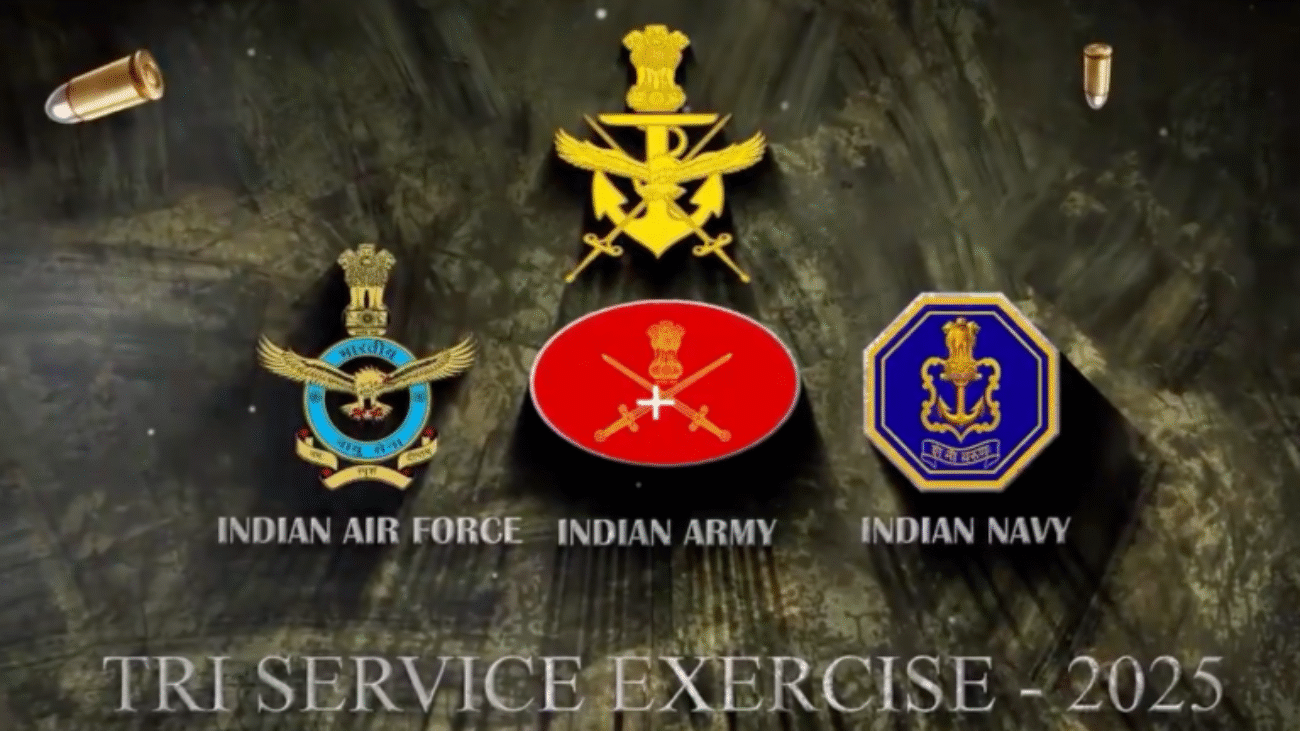
India continues to strengthen its defense readiness through large-scale joint exercises that bring together the Army, Navy, and Air Force in unified operations. Among these, Exercise Trishul 2025 stands out as one of the most important tri-service military drills conducted in recent years. Held from 3 November to 13 November 2025, this joint exercise was designed to test India’s integrated combat capabilities, enhance inter-service coordination, and ensure preparedness against modern security challenges.
Exercise Trishul represents India’s evolving defense strategy—one that focuses on jointness, real-time coordination, advanced technology, and seamless communication among all three branches of the Armed Forces. In a world where warfare is multi-domain and threats are unpredictable, such exercises have become essential for national security.
⭐ What Is Exercise Trishul?
Exercise Trishul is a tri-service military exercise—meaning it involves:
- Indian Army
- Indian Navy
- Indian Air Force
The goal is to train these forces to operate together during large-scale conflicts, natural disasters, and hybrid warfare situations. The exercise also includes simulations that reflect real battlefield environments, such as:
- Joint coastal defense
- Amphibious operations
- Air-land integrated attacks
- Special forces missions
- Cyber and electronic warfare
Unlike routine drills, Exercise Trishul is far more comprehensive, covering land, sea, air, cyber, and space-linked operations.
🛡️ Objectives of Exercise Trishul 2025
The 2025 edition focused on preparing India for future warfare. Its key objectives included:
🔹 1. Enhancing Tri-Service Coordination
The exercise tested how well the Army, Navy, and Air Force could plan, communicate, and execute missions together under complex scenarios.
🔹 2. Testing Multi-Domain Combat Strategy
Modern war is no longer limited to the battlefield. Trishul 2025 emphasized:
- Air dominance
- Naval strike capability
- Ground superiority
- Cyber defense
- Electronic warfare
- Surveillance and reconnaissance
🔹 3. Strengthening Coastal & Maritime Security
Given the geopolitical environment in the Indian Ocean Region, maritime security was a major focus. Naval assets and Air Force aircraft jointly practiced coastal surveillance and maritime interdiction.
🔹 4. Realistic Combat Scenario Training
The exercise simulated real conflict environments involving:
- Enemy drone attacks
- Precision missile strikes
- Amphibious landings
- Joint humanitarian missions
- Evacuation operations
🔹 5. Boosting Inter-Operability
With all three forces using different equipment and technology, Trishul allowed them to develop inter-operable systems for joint missions.
🚀 Major Highlights of Exercise Trishul 2025
Exercise Trishul 2025 was notable for many reasons. Here are some of the major highlights:
🔸 1. Large-Scale Deployment
Dozens of aircraft, naval vessels, armored vehicles, and special forces units were deployed for the exercise. The scale of participation showed India’s preparedness for full-spectrum operations.
🔸 2. Advanced AI-Driven Simulations
AI and digital systems were used for:
- Predictive battlefield mapping
- Enemy movement simulations
- Cyber breach simulations
- Real-time war-gaming analysis
This reflects India’s focus on next-generation warfare.
🔸 3. Special Forces Integrated Operations
Elite groups such as:
- MARCOS
- Para (SF)
- Garud Commandos
conducted joint missions, including hostage rescue, night operations, and urban combat drills.
🔸 4. Tri-Service Amphibious Landings
Combined Army-Navy-Air Force teams practiced:
- Beach assaults
- Landing craft deployment
- Helicopter-assisted troop insertion
These are crucial for any future coastal conflict scenario.
🔸 5. Air-Sea Combat Coordination
Fighter jets, transport aircraft, naval destroyers, and submarines came together for:
- Anti-ship strikes
- Reconnaissance missions
- Maritime patrol
- Aerial refueling
🌏 Why Exercise Trishul 2025 Matters for India
✔️ Strengthens India’s Defense Readiness
With rising regional tensions and global instability, India must remain combat-ready. Trishul ensures that the Armed Forces can respond quickly and collectively.
✔️ Supports India’s Vision of a Joint Theater Command
India is moving toward a theater command structure where all three services operate under unified leadership. Trishul provides a practical foundation for this future.
✔️ Boosts India’s Maritime Dominance
The exercise strengthens coastal security, especially in sensitive regions like the Arabian Sea, Bay of Bengal, and the Indian Ocean.
✔️ Improves Disaster Response Capability
India often faces natural disasters—floods, cyclones, earthquakes. Tri-service operations become crucial in evacuation, rescue, and humanitarian assistance.
✔️ Shows India’s Technological Progress
From AI simulations to advanced aircraft and warships, the exercise showcases India’s growing defense capabilities.
🔮 Exercise Trishul & Future Warfare
Modern wars are expected to involve:
- Drones
- Cyber attacks
- Artificial intelligence
- Space-based surveillance
- Electronic warfare
- Hybrid threats
Exercise Trishul 2025 trains India’s forces for all these domains. It prepares the country for multi-domain operations, where the battle is fought simultaneously on land, sea, air, cyber, and space.
🏁 Conclusion
Exercise Trishul 2025 reflects India’s commitment to building a strong, modern, and unified defense force. By enhancing coordination among the Army, Navy, and Air Force, it ensures that India remains prepared for any challenge—whether military, strategic, or humanitarian.
The exercise is a strong message to the world that India is ready, capable, and confident in defending its interest across all domains. As warfare evolves, India’s tri-service exercises like Trishul will play a key role in shaping the nation’s defense future.

Leave A Comment