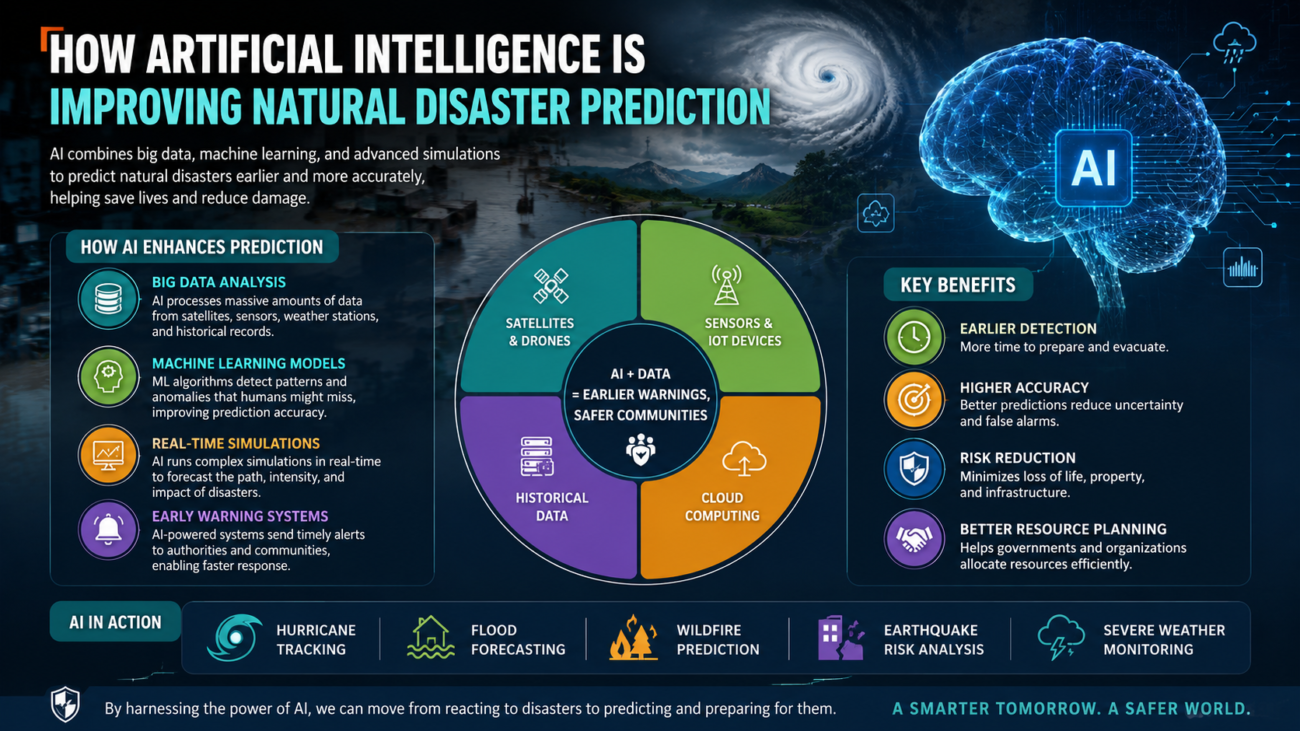
Natural disasters have always been among the greatest challenges faced by humanity. Earthquakes, hurricanes, floods, wildfires, tsunamis, and landslides claim thousands of lives every year while causing billions of dollars in economic losses. Although scientists have significantly improved weather forecasting and disaster monitoring over the decades, predicting the exact timing, location, and severity of many natural disasters remains a complex task. Today, Artificial Intelligence (AI) is transforming this landscape by enabling faster data analysis, more accurate predictions, and earlier warning systems that help governments and communities prepare before disasters strike.
Artificial Intelligence is no longer limited to chatbots or automation in businesses. It has become a powerful technology for environmental monitoring, climate analysis, and disaster management. By processing massive volumes of real-time and historical data, AI helps experts identify hidden patterns that traditional methods often overlook. As climate change continues to increase the frequency and intensity of natural disasters, AI is becoming an essential tool for protecting lives, infrastructure, and ecosystems.
Understanding AI in Disaster Prediction
Artificial Intelligence refers to computer systems capable of performing tasks that typically require human intelligence, such as learning from data, recognizing patterns, making predictions, and improving over time. In disaster prediction, AI combines machine learning, deep learning, computer vision, satellite imagery, sensor networks, weather models, and geographic information systems (GIS) to analyze environmental conditions continuously.
Unlike conventional forecasting systems that rely on predefined mathematical models, AI learns from millions of historical observations and adapts as new information becomes available. This ability allows AI systems to detect subtle environmental changes that may indicate an approaching disaster.
Processing Massive Amounts of Environmental Data
One of AI’s greatest strengths is its ability to process enormous datasets within seconds. Modern disaster prediction depends on information collected from satellites, weather stations, ocean buoys, drones, seismic sensors, radar systems, and Internet of Things (IoT) devices. Each of these sources generates vast amounts of data every minute.
Traditional data analysis methods often struggle to interpret such complex information quickly. AI algorithms can analyze these datasets simultaneously, identify meaningful relationships, and generate accurate forecasts in real time. This enables meteorologists and disaster management agencies to make faster and more informed decisions.
Improving Weather Forecasting Accuracy
Weather prediction has benefited enormously from Artificial Intelligence. AI-powered forecasting models continuously learn from historical weather data while incorporating live satellite images, atmospheric pressure, humidity levels, ocean temperatures, and wind patterns.
Machine learning models can identify subtle atmospheric changes that often precede storms, heavy rainfall, cyclones, or heatwaves. This improves forecast accuracy while reducing false alarms. Earlier and more reliable weather warnings give communities additional time to prepare, evacuate vulnerable areas, and secure important infrastructure.
Several national meteorological agencies are already integrating AI into their forecasting systems to improve both short-term weather predictions and long-range climate modeling.
AI and Flood Prediction
Floods remain one of the most common and destructive natural disasters worldwide. Predicting floods requires analyzing rainfall intensity, river levels, soil moisture, drainage systems, topography, and weather forecasts simultaneously.
Artificial Intelligence excels at combining these diverse datasets to estimate flood risks with remarkable precision. AI models can predict which regions are likely to experience flooding hours or even days before water levels become dangerous.
Real-time flood prediction enables emergency responders to issue evacuation orders, deploy rescue teams, and protect critical infrastructure before floodwaters arrive. This proactive approach significantly reduces both casualties and property damage.
Predicting Wildfires Before They Spread
Wildfires have become increasingly severe due to rising temperatures and prolonged drought conditions. Detecting fires during their earliest stages is critical because small fires can quickly become uncontrollable under strong winds.
AI-powered systems analyze satellite imagery, thermal cameras, humidity, vegetation conditions, wind speed, and historical fire patterns to identify areas at high risk. Computer vision algorithms can even detect smoke from surveillance cameras before human observers notice it.
Early wildfire detection allows firefighters to respond immediately, preventing minor incidents from developing into catastrophic forest fires.
Earthquake Monitoring and Risk Analysis
Accurately predicting earthquakes remains one of science’s greatest challenges. While AI cannot currently predict the exact moment an earthquake will occur, it has significantly improved earthquake monitoring and risk assessment.
Machine learning algorithms analyze seismic activity, fault line behavior, geological data, and historical earthquake records to identify regions experiencing unusual seismic patterns. AI also assists researchers in recognizing small tremors that may indicate increasing geological stress.
In addition, AI helps governments evaluate which buildings and infrastructure are most vulnerable during earthquakes, allowing authorities to strengthen critical structures before disasters occur.
Hurricane and Cyclone Tracking
Hurricanes and tropical cyclones can rapidly change direction and intensity, making accurate forecasting essential. AI models process satellite images, ocean temperatures, atmospheric conditions, and wind patterns to estimate storm development more precisely than traditional methods alone.
Deep learning algorithms continuously update storm predictions as new data arrives, providing emergency agencies with more reliable information regarding storm paths, expected rainfall, wind speeds, and landfall locations.
Improved tracking allows residents to receive evacuation notices earlier while enabling governments to position emergency resources where they are needed most.
AI-Powered Early Warning Systems
Perhaps the most valuable contribution of Artificial Intelligence is strengthening early warning systems. Modern AI platforms continuously monitor environmental conditions around the clock, automatically detecting signs of potential disasters.
When dangerous conditions are identified, AI systems can instantly send alerts to government agencies, emergency responders, mobile applications, television networks, and public warning systems. Automated alerts reduce delays that may occur with manual monitoring.
Faster communication means communities have more time to evacuate, prepare emergency supplies, and avoid hazardous areas before disasters strike.
Supporting Disaster Response After Predictions
Artificial Intelligence continues to assist even after a disaster occurs. AI-powered drones, satellite analysis, and computer vision help emergency responders assess damage quickly by identifying collapsed buildings, flooded roads, blocked transportation routes, and isolated communities.
Rescue teams can prioritize areas with the greatest need while logistics systems optimize the delivery of food, water, medicine, and emergency supplies. AI also helps insurance companies estimate damages more efficiently and supports governments during recovery planning.
Challenges and Limitations
Despite its tremendous potential, Artificial Intelligence is not a perfect solution. Prediction accuracy depends heavily on the quality and availability of data. In many developing countries, limited sensor networks and outdated infrastructure restrict AI performance.
Extreme weather events influenced by climate change can also produce conditions that differ from historical records, making predictions more difficult. Additionally, AI systems require significant computing resources, continuous model training, and close collaboration between scientists, governments, and technology companies.
Ethical concerns surrounding data privacy, transparency, and algorithm reliability must also be addressed to ensure responsible deployment of AI in disaster management.
The Future of AI in Natural Disaster Prediction
The future of Artificial Intelligence in disaster prediction is highly promising. As satellite technology, IoT devices, high-performance computing, and machine learning continue to advance, AI systems will become even faster and more accurate.
Future innovations may include digital twins of cities for disaster simulations, AI-driven climate models with improved long-term forecasting, autonomous disaster-monitoring drones, and smart emergency management systems capable of coordinating rescue operations automatically.
International collaboration and open environmental data sharing will further enhance AI’s ability to predict disasters across borders, creating a more resilient global response network.
Conclusion
Artificial Intelligence is revolutionizing the way humanity predicts and prepares for natural disasters. By analyzing enormous volumes of environmental data, identifying hidden patterns, and delivering real-time insights, AI enables earlier warnings and more accurate forecasts than ever before. From flood prediction and wildfire detection to hurricane tracking and earthquake monitoring, AI is helping governments, scientists, and emergency responders make faster, smarter decisions that save lives and reduce economic losses.
While challenges such as data quality and infrastructure limitations remain, ongoing advancements in AI technology promise even greater improvements in disaster prediction. As climate-related risks continue to grow worldwide, embracing Artificial Intelligence will be essential for building safer, more resilient communities capable of responding effectively to future natural disasters.

Leave A Comment