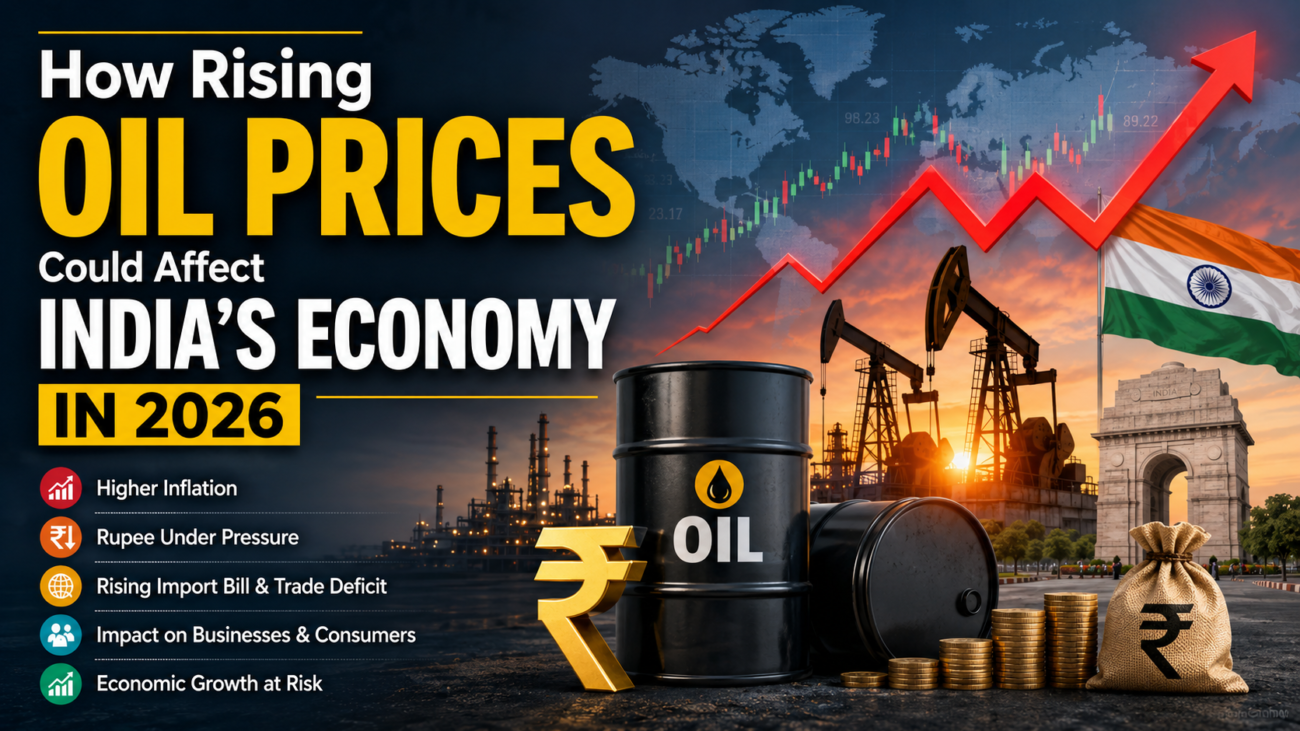
Oil prices have once again become one of the biggest economic concerns for India in 2026. With global crude prices rising sharply amid geopolitical tensions in the Middle East, India is facing renewed pressure on inflation, the rupee, imports, government finances and economic growth. Since India depends heavily on imported crude oil, changes in international oil prices can quickly influence the country’s economic outlook.
The issue has become particularly important in August 2026. Brent crude prices recently moved above $90 per barrel as tensions surrounding Iran and the Middle East increased. Indian financial markets have reacted negatively to the oil shock, while the Indian rupee has also come under pressure.
The International Monetary Fund has already identified higher oil prices and a weak monsoon as major risks to India’s economic growth in FY2026-27. Although India’s economy is still expected to grow at a relatively strong pace, prolonged energy-price pressure could make that growth more difficult to sustain.
Why Is India So Vulnerable to Rising Oil Prices?
India is one of the world’s largest consumers of crude oil but produces only a relatively small portion of its requirements domestically. As a result, the country has to import a large share of the crude oil used by its refineries.
Recent estimates put India’s dependence on imported oil at around 80% or more, depending on the measurement used. Reuters reported in August 2026 that India imports more than 90% of its crude needs, highlighting the country’s significant exposure to international oil markets.
This means that when crude prices increase, Indian companies and consumers ultimately face higher energy costs. Even if the government temporarily absorbs some of the increase through taxes, subsidies or pricing decisions, the broader economy can still feel the impact.
1. Higher Oil Prices Can Increase Inflation
One of the most immediate effects of expensive crude oil is inflation.
Oil is not only used to produce petrol and diesel. It is also an important input for transportation, manufacturing, agriculture, chemicals, plastics, packaging and many other industries.
When fuel and transportation costs increase, companies may pass those additional expenses to consumers through higher prices.
For example, higher diesel prices can increase the cost of transporting vegetables, fruits, grains and manufactured products from one part of India to another. Higher energy costs can also affect factories, logistics companies, airlines and construction businesses.
India’s retail inflation was already 4.45% year-on-year in July 2026, according to Reuters, with food inflation contributing significantly to the increase. Higher energy prices could add another layer of pressure if the oil shock persists.
2. The Indian Rupee Could Come Under Pressure
Rising oil prices can also weaken the Indian rupee.
India pays for a large portion of its crude imports in US dollars. When crude becomes more expensive, Indian oil companies need more dollars to purchase the same amount of energy.
This increases demand for dollars and can put downward pressure on the rupee.
The impact is already visible in 2026. On August 18, the rupee was trading around ₹95.68 per US dollar as higher oil prices and Middle East tensions increased pressure on the currency. The Reserve Bank of India was reported to have intervened in the foreign exchange market to limit excessive volatility.
A weaker rupee can make imported products more expensive, creating another channel through which oil prices can contribute to inflation.
3. India’s Import Bill Could Rise
Perhaps the most direct economic impact is an increase in India’s oil import bill.
When crude prices rise, India has to spend more money on imports even if the physical quantity of crude imported remains unchanged.
According to an analysis published by The Indian Express, India imports roughly 1.8–2 billion barrels of crude annually. Every $1 increase in the price of a barrel can therefore add up to around $2 billion to the annualised oil import bill.
This can significantly affect India’s external balance.
The pressure was visible in India’s July 2026 trade figures. The merchandise trade deficit reached $31.98 billion, a six-month high, while the country’s oil import bill remained elevated because of higher global crude prices.
4. Current Account and Trade Deficit Risks
India’s current account is closely connected to its trade balance.
When the value of crude oil imports increases sharply, the trade deficit can widen unless exports or other foreign-exchange earnings rise enough to offset the additional cost.
A larger trade deficit can increase pressure on the rupee and make India’s external sector more vulnerable.
However, India has some important buffers. Strong services exports, foreign investment, remittances and substantial foreign-exchange reserves can help absorb temporary shocks.
In August 2026, India’s foreign-exchange reserves were reported to have exceeded $700 billion, providing an important cushion against external volatility.
5. Petrol and Diesel Prices Could Affect Consumers
For ordinary households, the impact of rising oil prices is often most noticeable through fuel and transportation costs.
Higher petrol and diesel prices can increase commuting expenses for individuals and operating costs for businesses.
Even if retail fuel prices do not immediately rise by the same amount as international crude prices, sustained increases can eventually create pressure on fuel pricing, taxes, margins and government finances.
Higher transportation costs can also affect food delivery, logistics, public transportation and the movement of essential goods.
This makes oil prices an important issue not only for economists and investors but also for everyday consumers.
6. Businesses Could Face Higher Costs
Indian businesses across multiple industries could be affected by rising oil prices.
Transportation-heavy sectors such as logistics, aviation, tourism and e-commerce may experience higher operating expenses. Manufacturing companies can also face increased costs for transportation, packaging, chemicals and energy.
Small and medium-sized businesses may be particularly vulnerable because they often have less ability to absorb sudden increases in input costs.
Companies with strong pricing power may pass higher costs to customers, while others may have to accept lower profit margins.
This can create a difficult environment where companies face increasing costs but consumers become more cautious about spending.
7. Government Finances Could Come Under Pressure
The government also has to manage the economic consequences of higher oil prices.
India can use taxation, fuel-price policies and other measures to reduce the immediate impact on consumers. However, prolonged intervention can create fiscal pressure.
If the government reduces taxes on petroleum products to control inflation, it could lose revenue. On the other hand, if it maintains taxes while crude prices rise sharply, consumers and businesses may face greater cost pressure.
Therefore, policymakers have to balance inflation control, government revenue and economic growth.
8. RBI Monetary Policy Could Become More Challenging
The Reserve Bank of India could also face a difficult policy environment.
If higher oil prices push inflation upward while economic growth slows, the RBI would have to carefully balance its inflation target with the need to support economic activity.
Higher inflation could reduce the scope for interest-rate cuts. If inflation becomes persistent, markets could even begin to anticipate tighter monetary policy.
At the same time, aggressively raising interest rates to counter an oil-driven inflation shock could negatively affect investment and consumption.
This creates what economists often describe as a difficult policy trade-off.
9. Stock Market Volatility May Increase
Oil prices can influence the Indian stock market through several channels.
Companies that consume large amounts of fuel or petroleum-based inputs may see their profit margins come under pressure. Investors may also become concerned about inflation, interest rates and the rupee.
Indian equities have already shown sensitivity to the latest oil-price movements. On August 18, 2026, the Nifty 50 and Sensex both declined as crude prices moved above $90 per barrel and geopolitical tensions increased.
However, not every company loses when oil prices rise. Oil producers, refiners and some energy-related businesses may benefit depending on their business models, inventory positions and pricing structures.
10. India’s Energy Strategy Could Change
The biggest long-term lesson from rising oil prices is the importance of reducing dependence on imported fossil fuels.
India has been expanding renewable energy, electric mobility, energy efficiency and alternative fuels. Continued investment in solar power, wind energy, electric vehicles, batteries, green hydrogen and public transportation can gradually reduce the economy’s exposure to crude oil shocks.
India is also diversifying its sources of crude imports. In July 2026, Russia accounted for more than half of India’s crude imports, while supplies from the Middle East declined amid regional disruptions.
Diversification can help reduce supply risks, although it cannot completely eliminate India’s exposure to global crude prices.
What Could Happen to India’s Economy in 2026?
The ultimate impact will depend on how long oil prices remain elevated.
If crude prices stay high for only a short period, India may be able to absorb the shock through its foreign-exchange reserves, diversified energy supplies, government measures and strong domestic economic activity.
However, a prolonged period of expensive oil could create more serious challenges. It could increase inflation, widen the trade deficit, weaken the rupee, raise business costs and reduce household purchasing power.
The IMF has already highlighted oil prices as one of the key downside risks to India’s FY2026-27 growth outlook. Fitch Ratings, meanwhile, continues to view India’s overall macroeconomic position as relatively resilient, forecasting 6.4% real GDP growth for FY2027 while also highlighting the risks associated with an energy shock.
Conclusion
Rising oil prices are more than an energy-market problem for India. They can affect almost every major part of the economy, from household budgets and transportation costs to inflation, imports, the rupee, government finances and economic growth.
India enters the second half of 2026 with important strengths, including substantial foreign-exchange reserves, strong services exports, a large domestic market and continued economic growth. Nevertheless, prolonged high oil prices could test these strengths.
The long-term solution lies in reducing India’s dependence on imported crude through renewable energy, electric mobility, domestic energy production, energy efficiency and diversified supply chains.
For India, the oil-price challenge in 2026 therefore has two dimensions: managing the immediate economic shock while accelerating the transition toward a more energy-secure economy. How effectively policymakers and businesses manage both challenges will play an important role in determining India’s economic performance in the months ahead.

Leave A Comment