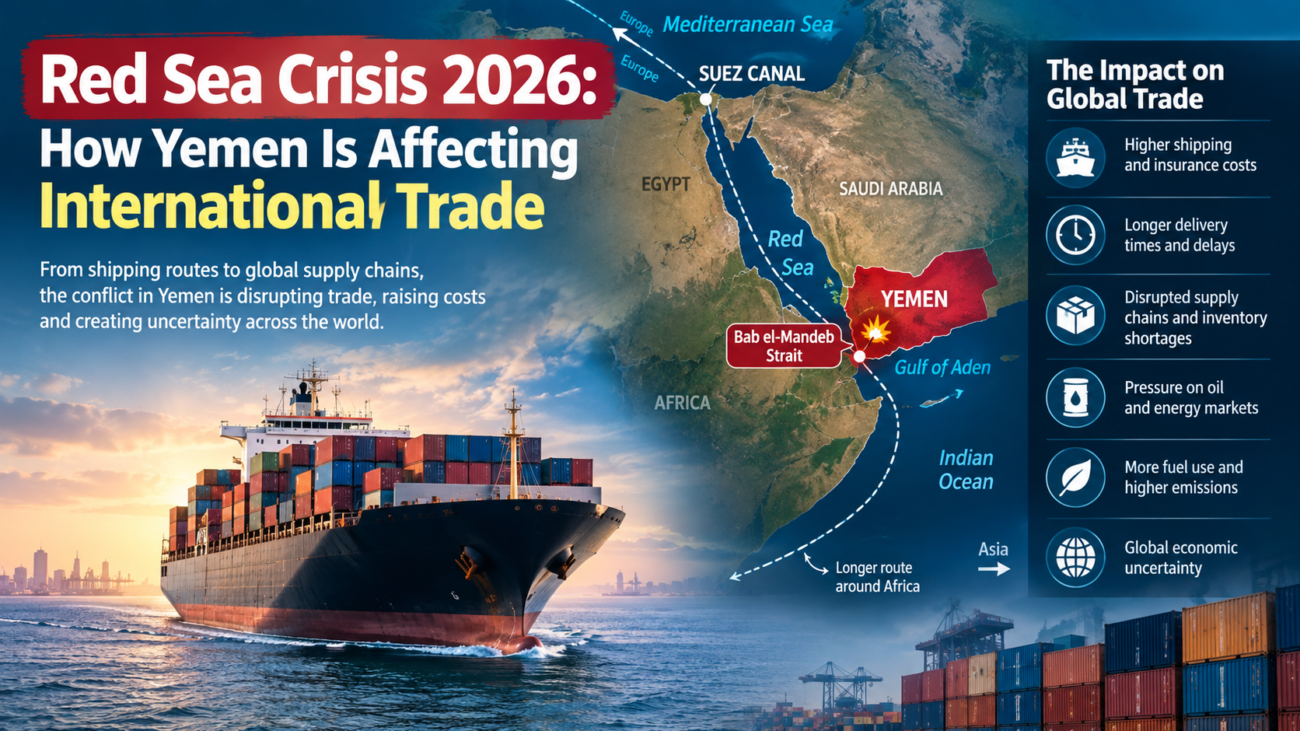
The Red Sea crisis in 2026 has once again placed Yemen at the centre of international trade and maritime security concerns. The strategic location of Yemen gives the conflict significance far beyond its borders because the country lies alongside the Bab el-Mandeb Strait, a narrow maritime passage connecting the Red Sea with the Gulf of Aden and the wider Indian Ocean.
For international shipping, this route is particularly important because vessels travelling between Asia and Europe can use the Red Sea and the Suez Canal instead of sailing around the southern tip of Africa. Renewed attacks and instability around Yemen have therefore created risks for ships, crews, cargo and global supply chains.
The International Maritime Organization (IMO) warned in July 2026 that renewed attacks on international shipping in the Red Sea threaten shipping security, seafarers, the marine environment and the stability of global supply chains.
Why Yemen Matters to Global Trade
Yemen’s geographical position makes it strategically important to international maritime commerce. The Bab el-Mandeb Strait acts as a gateway between the Red Sea and the Gulf of Aden.
Ships travelling from Asian manufacturing centres to European markets can pass through the Indian Ocean, Gulf of Aden, Bab el-Mandeb, Red Sea and Suez Canal before entering the Mediterranean. This route significantly reduces the distance compared with sailing around Africa.
When security conditions deteriorate around Yemen, shipping companies have to reconsider whether the shorter route is worth the additional security risk.
The problem is not limited to Yemen itself. A disruption around the Bab el-Mandeb can affect ports, shipping schedules, insurance markets, fuel consumption and the cost of transporting goods thousands of kilometres away.
Renewed Attacks on Ships in 2026
The security situation has remained serious during 2026. The IMO has continued monitoring attacks affecting international shipping in the Red Sea region. In August, the organization condemned a deadly attack involving the cargo ship TIHAMAH off the coast of Al Mokha, Yemen, in which several seafarers were killed.
The attacks have created a difficult operating environment for shipping companies. Operators must consider the safety of crews, cargo and vessels before deciding whether to use the Red Sea route.
The situation has also developed alongside wider Middle Eastern tensions. In September 2026, Houthi forces expanded their control around strategic areas near the Red Sea, while attacks and counter-attacks involving Saudi Arabia added another layer of uncertainty to maritime trade.
Shipping Companies Face a Difficult Choice
When ships avoid the Red Sea and Suez Canal, one major alternative is to travel around the Cape of Good Hope at the southern tip of Africa.
This can keep cargo moving, but the alternative route is considerably longer.
A longer journey means ships consume more fuel and spend more time at sea. Shipping companies may also face higher crew expenses, insurance costs and operational costs.
UN Trade and Development (UNCTAD) previously documented how Red Sea disruptions forced vessels to take longer routes around Africa. Its analysis found that rerouting increased vessel demand and container-ship demand, while also creating additional costs and delays.
Therefore, even when goods continue moving, the crisis can make international trade more expensive.
Impact on Global Supply Chains
Modern supply chains depend on predictable transportation. Manufacturers often plan production around the expected arrival of raw materials, components and finished products.
A disruption in the Red Sea can therefore have a chain reaction.
For example, a European company importing products from Asia could face longer delivery times if its shipping line avoids the Suez Canal. The company may then need additional inventory to prevent shortages.
Retailers can also experience delays in receiving consumer products. Manufacturers may face higher transportation costs, while importers may need to pay more for freight and insurance.
These additional expenses can eventually affect consumers through higher prices.
UNCTAD has previously warned that disruptions at major maritime chokepoints can increase shipping costs, delay deliveries and contribute to inflationary pressure.
Effect on Oil and Energy Markets
The Red Sea is also important for energy transportation.
Oil tankers and other energy carriers use maritime routes connecting the Middle East with global markets. Any prolonged disruption can force companies to reconsider routes and logistics.
In September 2026, attacks by Houthi forces affected Saudi energy infrastructure and contributed to disruptions around the Red Sea oil-export system. Reuters reported that crude loadings at Saudi Arabia’s Yanbu hub were temporarily halted following attacks, highlighting how developments around Yemen can affect wider energy markets.
Energy disruptions can have consequences far beyond the Middle East. Higher transportation costs or concerns about supply security can influence fuel prices, manufacturing expenses, freight rates and ultimately the prices paid by consumers.
What Does This Mean for India?
India is closely connected to international maritime trade and has strong commercial relationships with Europe, the Middle East and Asia.
A prolonged Red Sea disruption can increase transportation time and costs for Indian exporters and importers using Europe-bound routes.
Industries that depend heavily on imported raw materials, machinery, chemicals, energy products or components can be particularly sensitive to higher freight costs.
Indian exporters can also face longer delivery schedules when shipping companies divert vessels around Africa.
For businesses operating with tight delivery deadlines, even a relatively small increase in transit time can create problems with inventory planning and customer commitments.
The Environmental Cost of Rerouting
The Red Sea crisis also has an environmental dimension.
When ships travel significantly longer distances around Africa, they generally consume additional fuel and produce additional emissions.
UNCTAD has highlighted this problem in its analysis of disrupted maritime routes, noting that rerouting around the Cape of Good Hope increases travel distances, costs and carbon emissions.
This means that a geopolitical crisis can indirectly create an environmental impact thousands of kilometres from the original conflict zone.
Will International Trade Stop?
The Red Sea crisis does not mean that international trade will stop.
Global shipping companies have several ways to respond. They can reroute vessels, adjust schedules, increase security measures, change insurance arrangements and use alternative logistics networks.
Interestingly, shipping patterns in 2026 have not been completely one-directional. Some major carriers have begun restoring additional services through the Suez route despite continuing security concerns, demonstrating that companies are constantly balancing commercial efficiency against maritime risk.
However, the possibility of renewed attacks means that shipping decisions can change quickly.
Conclusion
The Red Sea Crisis 2026 demonstrates how a conflict concentrated around Yemen can affect international trade far beyond the Middle East.
Yemen’s location near the Bab el-Mandeb Strait gives developments there the potential to influence one of the world’s most important maritime corridors. Attacks on commercial vessels can increase security risks, force ships to take longer routes, raise freight and insurance costs, disrupt delivery schedules and place additional pressure on global supply chains.
The crisis also shows the vulnerability of modern international trade. Global commerce depends on a relatively small number of strategic maritime chokepoints. When one of these routes becomes unsafe, businesses around the world can feel the consequences.
As the situation develops through 2026, shipping companies, governments and international organizations will continue to monitor the Red Sea closely. The future of this vital trade corridor will depend not only on maritime security but also on developments in Yemen and the wider geopolitical situation across the Middle East.

Leave A Comment