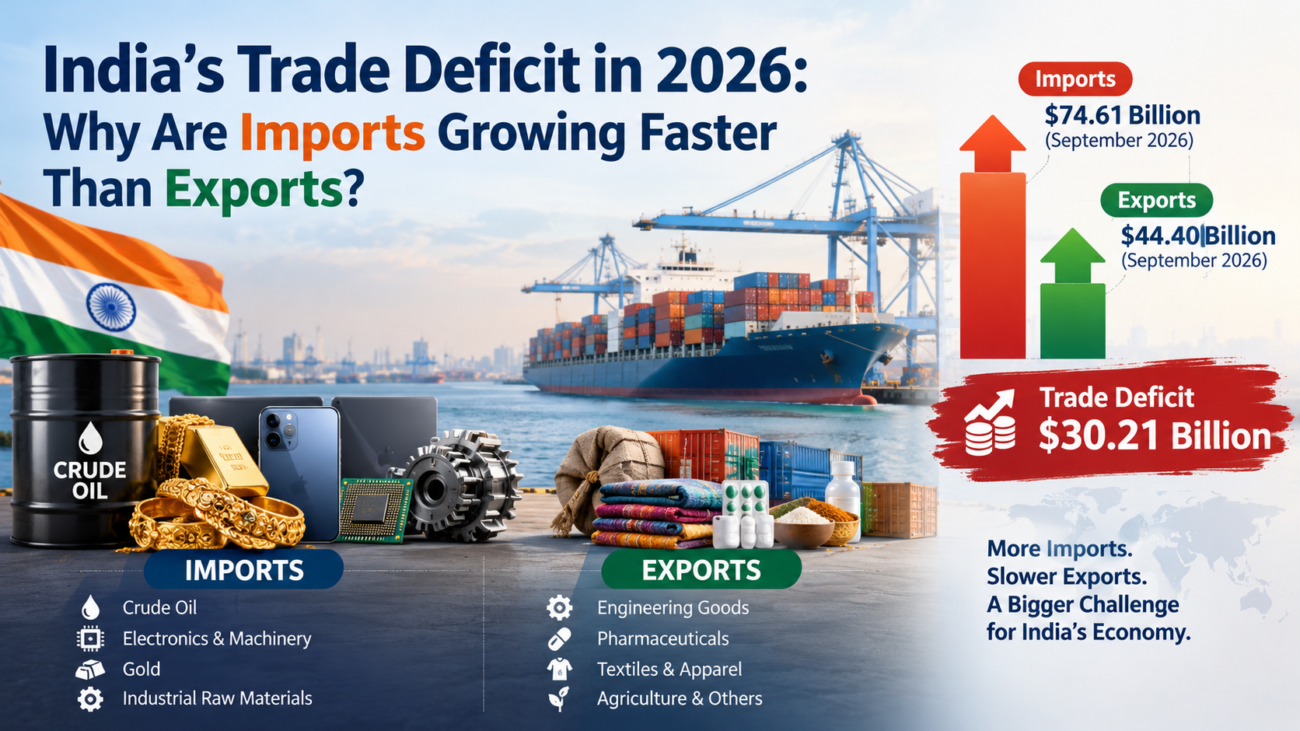
India is one of the world’s fastest-growing major economies, with expanding industries, rising consumer demand and increasing international trade. However, a major economic challenge continues to attract attention in 2026: India’s trade deficit. The country imports a wide range of goods, including crude oil, electronic components, machinery, gold and industrial raw materials. Although Indian exports are also growing, imports remain significantly higher than merchandise exports.
According to data released by the Ministry of Commerce and Industry on October 15, 2026, India’s merchandise exports reached $44.40 billion in September, while merchandise imports stood at $74.61 billion. This resulted in a merchandise trade deficit of $30.21 billion. The figures highlight an important question: why does India continue to import more goods than it exports, even as domestic manufacturing and export industries expand?
What Is India’s Trade Deficit?
A trade deficit occurs when the value of a country’s imports of goods exceeds the value of its exports over a particular period. For example, if India imports goods worth $100 billion and exports goods worth $70 billion, it records a merchandise trade deficit of $30 billion.
A trade deficit is not necessarily a sign of economic weakness. Imports can provide essential resources, advanced technology and machinery that support industrial growth. However, a persistent and widening deficit can increase the demand for foreign currency and create pressure on the country’s external balance.
It is also important to distinguish between the merchandise trade balance and the overall trade balance. India exports services such as information technology, business consulting and financial services, which help offset part of its goods trade deficit.
1. Heavy Dependence on Crude Oil Imports
One of the biggest reasons behind India’s trade deficit is its dependence on imported crude oil. Petroleum is essential for transportation, manufacturing, electricity generation in some applications, and several chemical industries.
India’s domestic oil production does not meet its total demand, making international purchases necessary. When global crude oil prices increase, the country may have to spend significantly more on imports, even if the volume of oil purchased remains relatively stable.
Geopolitical tensions, supply disruptions and changes in global energy markets can make the situation more difficult. Higher oil import bills increase production and transportation costs, potentially affecting businesses and consumers throughout the economy.
Expanding renewable energy, improving energy efficiency and increasing domestic energy production can help reduce this vulnerability over time.
2. Rising Demand for Electronics and Machinery
India’s digital economy, manufacturing sector and infrastructure projects require electronic components, semiconductors, industrial equipment and advanced machinery. Many of these products are imported because domestic manufacturing capacity and specialised technology are still developing.
The expansion of smartphones, electric vehicles, telecommunications, data centres and consumer electronics has increased demand for sophisticated components.
At the same time, India is making progress in exporting manufactured products. Government data shows that electronic goods exports reached $5.31 billion in September 2026, representing a 70.44% increase compared with September 2025.
This demonstrates that India’s electronics industry is growing, but it also highlights the importance of strengthening domestic component manufacturing. Producing more essential parts within the country could reduce import dependence and increase the value added by Indian manufacturers.
3. Gold Imports and Domestic Consumption
Gold is another important contributor to India’s import bill. The metal has cultural significance and is widely purchased for jewellery, weddings, festivals and investment purposes.
India’s domestic gold production is limited compared with its demand, so a substantial portion of consumption is met through imports. When international gold prices rise or household demand increases, the value of gold imports can place additional pressure on the trade balance.
However, gold imports can fluctuate considerably from month to month. The latest September 2026 figures showed that gold imports declined compared with the previous year, demonstrating that not every import category is necessarily responsible for a widening deficit in every period.
Encouraging transparent investment alternatives and supporting domestic jewellery manufacturing and exports could help improve the overall trade position.
4. Why Are Exports Not Growing Fast Enough?
India’s export performance has improved in several sectors, including engineering goods, petroleum products, chemicals, textiles and electronics. Nevertheless, Indian exporters face challenges such as international competition, logistics costs, quality standards, access to advanced technology and changing trade policies.
Small and medium-sized businesses may also struggle with financing, product certification, international marketing and distribution networks. These barriers can prevent them from reaching overseas customers at scale.
In addition, demand in major export markets can change because of slower economic growth, geopolitical uncertainty or new tariffs. Such developments may affect Indian businesses even when their domestic operations remain strong.
India therefore needs to increase not only the volume of exports but also the competitiveness, quality and technological value of the products it sells abroad.
5. The Role of Manufacturing and Trade Agreements
Strengthening domestic manufacturing is essential to reducing India’s long-term dependence on imported finished products and industrial components. Initiatives that encourage electronics production, industrial investment, research and development, and supply-chain development can help Indian companies compete globally.
Trade agreements can also provide exporters with improved access to international markets. In 2026, India is pursuing greater trade opportunities with partners including the United Kingdom, New Zealand, the European Union and the United States.
However, agreements alone cannot guarantee export growth. Indian businesses must also meet international quality requirements, deliver products on time and maintain competitive prices.
Better ports, faster customs procedures, efficient rail and road connectivity, and affordable access to export finance can help businesses reach international buyers more effectively.
6. What Does the Trade Deficit Mean for the Indian Economy?
A persistent trade deficit can increase demand for foreign currencies, particularly when import payments rise faster than export earnings. This can contribute to pressure on the rupee, although exchange rates are also influenced by capital flows, interest rates, global market conditions and central bank actions.
A weaker rupee can make imports more expensive, especially crude oil, machinery and electronic components. Businesses may pass some of these higher costs on to consumers, contributing to inflation.
Nevertheless, imports that support productive investment can benefit the economy in the long run. Machinery, technology and essential raw materials can improve productivity and help domestic industries expand. The key issue is whether India can convert these imports into stronger production, higher-value exports and sustainable economic growth.
Conclusion
India’s trade deficit in 2026 reflects a combination of energy dependence, demand for imported technology, gold consumption and the challenges of expanding internationally competitive exports. Recent figures also show that exports are making meaningful progress, particularly in electronics, engineering goods and petroleum products.
The priority is not simply to reduce imports at any cost. India must increase domestic value addition, strengthen manufacturing supply chains, improve export infrastructure and help businesses access international markets.
If these efforts continue, India can gradually reduce its dependence on essential imports while expanding its presence in global trade. A stronger export sector, supported by competitive manufacturing and innovation, will be crucial to achieving more balanced and sustainable economic growth.

Leave A Comment