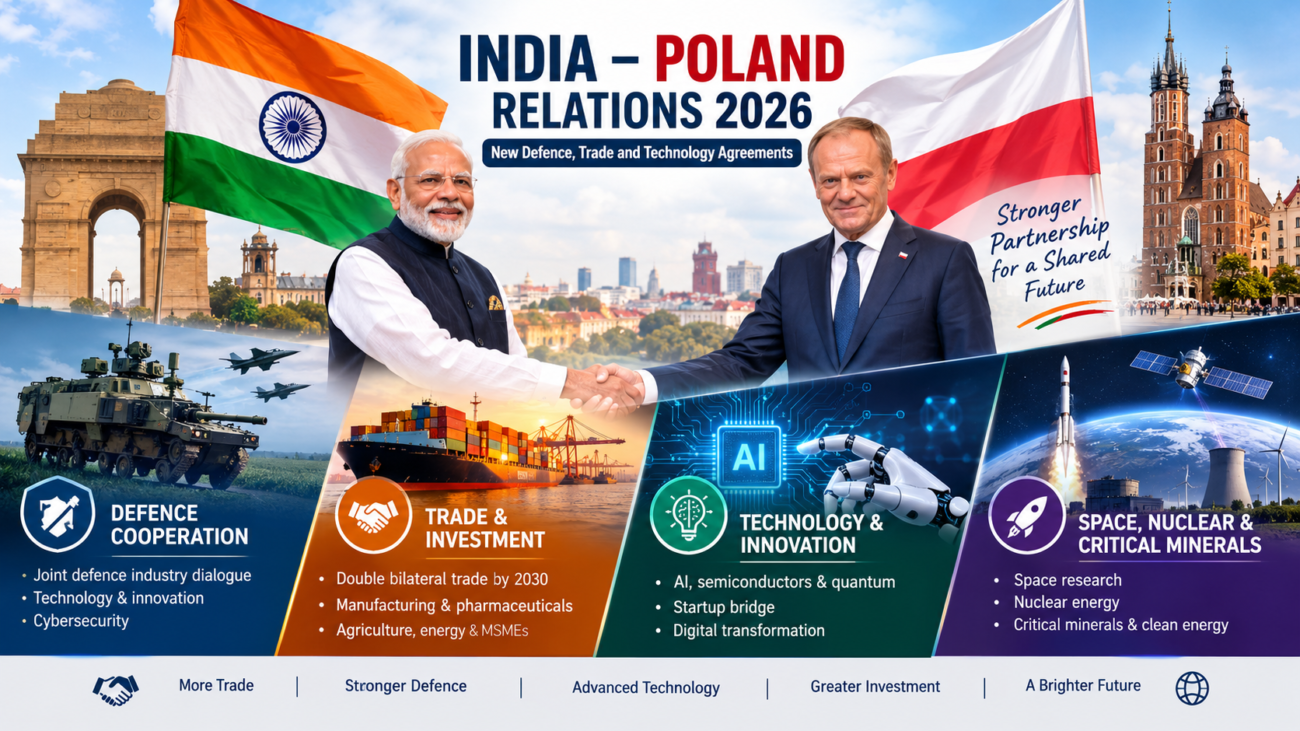
India and Poland are strengthening their relationship in 2026, with new initiatives covering defence, international trade, advanced technology, cybersecurity, space research and investment. The official visit of Polish Prime Minister Donald Tusk to India from 21 to 23 October 2026 marked an important step in this partnership. Prime Minister Narendra Modi and Prime Minister Tusk discussed ways to expand economic cooperation and build stronger strategic ties between the two countries.
The two countries are looking beyond traditional diplomatic relations and focusing on practical cooperation that can support economic growth, industrial development and security. Their latest discussions also reflect the importance of India’s relationship with Europe at a time when countries are seeking reliable trade partners and diversified supply chains.
A New Chapter in India–Poland Relations
India and Poland established diplomatic relations in 1954. Over the decades, their relationship has expanded through trade, education, cultural exchanges and industrial cooperation. In August 2024, Prime Minister Modi visited Poland, and both countries elevated their relationship to a Strategic Partnership. They also adopted an Action Plan for 2024–2028 to guide cooperation across several sectors.
In 2026, both governments are working to turn this partnership into measurable results. The October visit brought fresh momentum to their cooperation, with business representatives and government officials exploring opportunities in manufacturing, infrastructure, technology and defence.
One of the most significant developments was the agreement to double bilateral trade by 2030. The two governments also agreed to establish a Defence Industry Dialogue and strengthen cooperation in emerging technologies.
1. Defence Cooperation: A Major Priority in 2026
Defence has become an important area of India–Poland cooperation. Both countries recognise the need to strengthen their industrial capabilities, exchange expertise and respond to changing international security challenges.
During the October 2026 discussions, the two leaders welcomed the outcomes of the eighth meeting of the India–Poland Joint Working Group on Defence, held in Warsaw in September 2026. They also supported the establishment of a Defence Industry Dialogue to encourage cooperation between companies and defence organisations.
The proposed dialogue could create opportunities for defence technology partnerships, joint research, co-development and co-production, where mutually agreed. It may also encourage companies from both countries to explore commercially viable projects and share industrial expertise.
For India, this cooperation could support its broader ambition to strengthen domestic defence manufacturing and reduce excessive dependence on imported equipment. For Poland, closer engagement with Indian manufacturers could provide opportunities for industrial partnerships and access to a large and growing market.
Both countries have also highlighted cybersecurity, defence innovation and critical and emerging technologies as areas requiring closer attention. However, these initiatives should not be confused with a single comprehensive arms purchase agreement: the announced focus is on developing a framework for deeper industrial cooperation.
2. Trade and Investment: The Goal of Doubling Trade by 2030
Trade is another major pillar of the India–Poland relationship. According to the Embassy of India in Warsaw, bilateral trade reached approximately US$6.36 billion in 2025, compared with US$1.95 billion in 2013. This growth demonstrates the increasing economic importance of the partnership.
During the October 2026 visit, both governments agreed to double bilateral trade by 2030. The target is expected to encourage businesses to explore new markets, establish partnerships and increase investment in both countries.
India exports products such as textiles, pharmaceuticals, chemicals, engineering goods, electronic machinery and automotive products to Poland. In return, India imports machinery, electrical equipment, industrial components and other specialised products.
Several sectors could benefit from stronger cooperation:
Manufacturing: Polish companies can explore opportunities in Indian industrial production and infrastructure.
Pharmaceuticals: Indian pharmaceutical companies can expand their presence in European markets.
Agriculture and food processing: Both countries can increase business engagement and explore agricultural technology.
Mining and energy: Companies can collaborate on mining technologies, resource recovery and industrial efficiency.
Small businesses: Greater business-to-business engagement can help small and medium-sized enterprises establish international partnerships.
The India–European Union Free Trade Agreement is another important development. Negotiations were concluded in January 2026, creating the prospect of wider commercial opportunities between India and EU member states, including Poland. However, signing, ratification and implementation remain important steps before the agreement can deliver its full benefits.
3. Technology, Artificial Intelligence and Startups
Technology is emerging as one of the most promising areas of India–Poland cooperation. India has a large information technology industry, a growing startup ecosystem and expertise in digital services. Poland offers technological capabilities, research institutions and access to European business networks.
During the October visit, the leaders highlighted opportunities for collaboration in artificial intelligence (AI), semiconductors and quantum technologies. They also agreed to strengthen startup partnerships and cooperation between businesses, universities and research organisations.
An important announcement was the plan to establish an India–Poland Startup Bridge. This initiative is intended to create stronger links between entrepreneurs and innovation ecosystems in both countries. It could help startups explore international markets, connect with potential investors and develop joint technology projects.
Cybersecurity is another significant area. As businesses and governments increasingly depend on digital infrastructure, protecting sensitive information and critical systems has become essential. Cooperation between Indian IT companies and Polish technology firms could support the development of digital security solutions.
Both countries also see potential in semiconductor research, advanced computing and digital transformation. Although these areas offer considerable opportunities, their success will depend on investment, skilled professionals, research collaboration and the ability to convert proposals into practical projects.
4. Space, Nuclear Energy and Critical Minerals
Beyond IT and software, India and Poland are exploring cooperation in strategic industries. Space research is one such area, with both governments encouraging stronger institutional and industry-level engagement.
The leaders also expressed interest in closer cooperation on nuclear energy, as well as critical minerals and coal gasification. These sectors are relevant to energy security, industrial development and the transition towards more resilient supply chains.
Critical minerals are particularly important for batteries, electronics, electric vehicles and other advanced technologies. Both countries see opportunities in battery recycling, rare-earth mineral refining, geology and mining. A memorandum of understanding on cooperation in geology, mining and critical minerals was still under negotiation in the October joint statement; it should therefore not be described as an already signed agreement.
Renewable energy, sustainable technologies and disaster resilience also offer opportunities for future cooperation. Poland’s decision to join India’s Coalition for Disaster Resilient Infrastructure (CDRI) represents a concrete development in this area.
5. Education, Culture and People-to-People Relations
India and Poland are also working to strengthen cultural and educational ties. Universities in both countries have opportunities to develop academic partnerships, exchange students and faculty members, and undertake collaborative research.
Poland has a longstanding tradition of studying Indian languages, Sanskrit and Indian philosophy. The Indian Studies Chair at Jagiellonian University in Kraków provides another connection between the two societies.
Historical ties also remain important. During the Second World War, Indian princely states, including Jamnagar and Kolhapur, provided refuge to Polish women and children. These shared memories continue to support goodwill between the two countries. Both governments have expressed interest in expanding cultural programmes, tourism, sports and youth exchanges.
What Does the Future Hold for India–Poland Relations?
The 2026 developments show that India–Poland relations are expanding beyond conventional diplomacy. Defence manufacturing, trade, artificial intelligence, startups, space research and energy cooperation are becoming central to the partnership.
The biggest challenge will be implementation. Doubling trade by 2030 will require stronger commercial links, investment, smoother market access and sustained engagement between businesses. Defence and technology initiatives will similarly depend on funding, regulatory cooperation and agreements that translate discussions into working projects.
For India, Poland can serve as an important economic partner and a gateway to markets in Central and Eastern Europe. For Poland, India offers a large consumer market, a skilled workforce and opportunities to diversify international partnerships.
Conclusion
India–Poland relations in 2026 have entered an important phase, supported by a clear trade target, plans for a Defence Industry Dialogue and new initiatives in technology and innovation. Cooperation in space, nuclear energy, critical minerals and education adds further depth to the relationship.
If both governments successfully implement their commitments, this partnership could create new business opportunities, strengthen industrial capabilities and improve technological cooperation. The real measure of success, however, will be how effectively the announcements translate into signed agreements, investments, joint projects and lasting economic benefits.

Leave A Comment