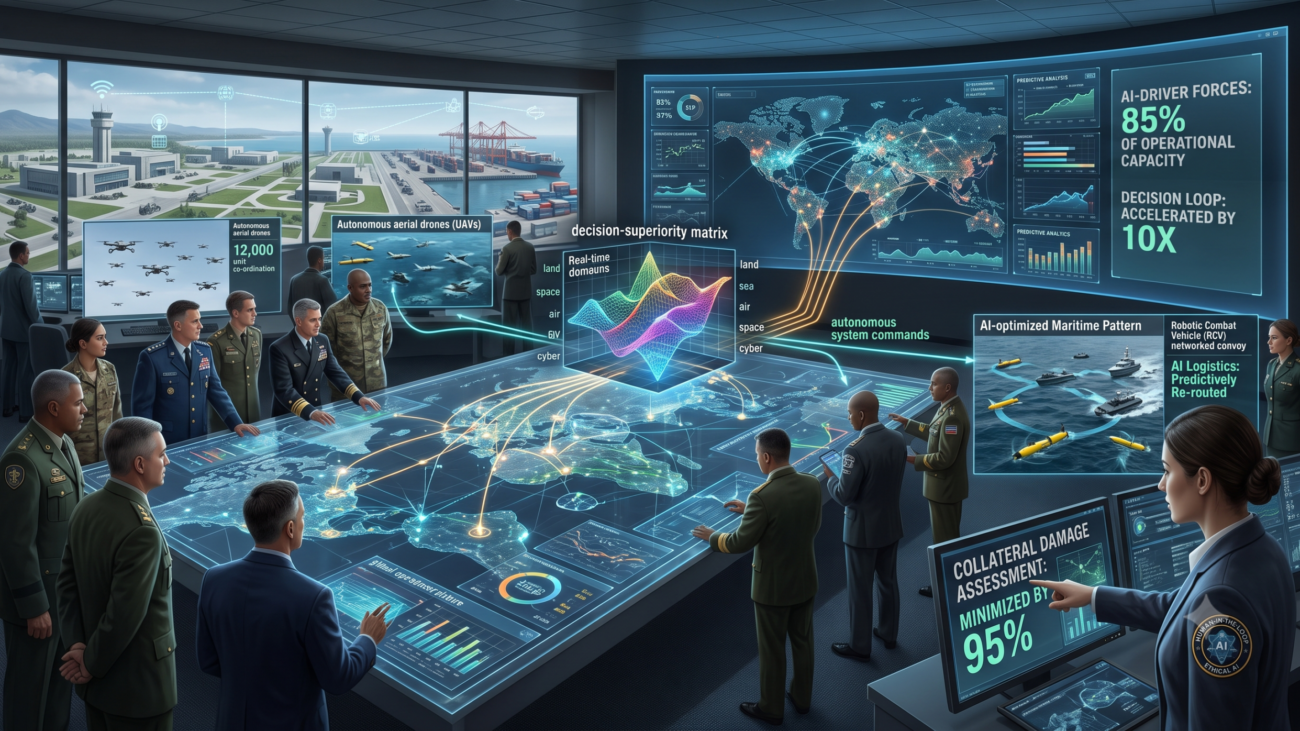
Artificial Intelligence (AI) is no longer a futuristic concept—it has become a defining force in modern warfare. Around the world, military organizations are investing billions of dollars in AI-powered technologies to enhance decision-making, improve battlefield awareness, strengthen cybersecurity, and develop autonomous systems. From drone swarms and predictive intelligence to cyber warfare and autonomous naval vessels, AI is transforming the way nations prepare for and conduct military operations.
As global geopolitical tensions continue to rise, countries such as the United States, China, Russia, India, the United Kingdom, and several NATO members are integrating AI into their defense strategies. This technological race is not only changing military capabilities but also redefining international security and strategic competition.
The Rise of AI in Modern Warfare
Traditional warfare relied heavily on manpower, conventional weapons, and human decision-making. Today, AI enables militaries to process massive amounts of intelligence data within seconds, identify threats, and recommend strategic actions faster than any human analyst.
Machine learning algorithms can analyze satellite imagery, radar signals, social media activity, and battlefield communications to detect unusual patterns and predict enemy movements. This allows commanders to make faster, more informed decisions during critical missions.
Rather than replacing soldiers entirely, AI is increasingly acting as a force multiplier—helping military personnel perform their duties more efficiently while reducing operational risks.
Autonomous Weapons and Drone Technology
One of the most visible examples of AI in military operations is the growing use of autonomous drones and unmanned combat systems.
AI-powered drones can:
Conduct surveillance over hostile territories.
Track moving targets in real time.
Assist in search-and-rescue operations.
Deliver precision strikes with minimal human intervention.
Operate in coordinated drone swarms.
Drone swarm technology is especially significant. Instead of deploying one expensive aircraft, militaries can launch hundreds of interconnected AI-controlled drones that communicate with one another, overwhelm enemy defenses, and adapt to changing battlefield conditions.
This capability is changing military tactics by making operations faster, more flexible, and less dependent on human pilots.
AI-Powered Intelligence and Surveillance
Modern military intelligence depends on collecting enormous amounts of information from satellites, aircraft, naval systems, cyber networks, and human sources.
AI dramatically improves intelligence gathering by:
Processing millions of data points instantly.
Identifying suspicious military movements.
Detecting hidden infrastructure.
Recognizing faces and vehicles.
Predicting possible attack scenarios.
Instead of spending days reviewing surveillance footage, intelligence officers can receive AI-generated alerts within minutes, allowing faster responses to emerging threats.
Predictive analytics also helps governments anticipate geopolitical developments before they escalate into armed conflicts.
Cyber Warfare Enters a New Era
As warfare increasingly shifts into the digital domain, cybersecurity has become as important as traditional defense systems.
AI is transforming cyber warfare by enabling both defensive and offensive capabilities.
Defensive Applications
Military organizations use AI to:
Detect malware automatically.
Identify network intrusions.
Monitor unusual system behavior.
Respond to cyberattacks in real time.
Protect classified information.
Offensive Applications
AI can also be used to:
Identify vulnerabilities in enemy networks.
Automate cyber reconnaissance.
Launch adaptive cyber operations.
Disrupt communication systems.
Because cyberattacks can occur within milliseconds, AI provides the speed necessary to defend critical military infrastructure against increasingly sophisticated threats.
Faster Military Decision-Making
Military success often depends on making the right decision before an opponent does.
AI-powered command-and-control systems combine information from multiple sources, including:
Satellites
Ground sensors
Aircraft
Naval fleets
Battlefield communications
Intelligence reports
The system analyzes the information and recommends possible courses of action based on probability, historical data, and real-time conditions.
Although final decisions generally remain with human commanders, AI significantly shortens the decision-making cycle, giving armed forces a strategic advantage.
Logistics and Supply Chain Optimization
Military operations require massive logistical coordination involving fuel, ammunition, medical supplies, food, and transportation.
AI improves military logistics by:
Forecasting supply requirements.
Optimizing transportation routes.
Predicting equipment failures.
Scheduling preventive maintenance.
Reducing operational costs.
Predictive maintenance is particularly valuable. AI systems analyze data from military vehicles, aircraft, and ships to identify potential mechanical failures before they occur, reducing downtime and increasing operational readiness.
AI in Naval and Air Defense
Modern naval forces are increasingly deploying AI-powered autonomous surface vessels and underwater drones for surveillance, mine detection, and anti-submarine operations.
Similarly, air defense systems use AI to:
Track incoming missiles.
Differentiate real threats from decoys.
Coordinate interceptor systems.
Improve radar accuracy.
Reduce response times.
These technologies enhance national defense while minimizing human workload during high-pressure situations.
Ethical and Legal Challenges
Despite its many advantages, AI raises serious ethical and legal concerns.
One of the biggest debates centers on autonomous lethal weapons capable of selecting and engaging targets without direct human control.
Critics argue that such systems could:
Increase accidental civilian casualties.
Create accountability issues.
Escalate conflicts more rapidly.
Be vulnerable to hacking or manipulation.
Reduce meaningful human oversight.
International organizations and policymakers continue to discuss regulations that ensure AI remains under responsible human control while complying with international humanitarian law.
The Global AI Arms Race
AI has become a strategic priority for major world powers.
The United States continues to invest heavily in AI-enabled defense technologies through collaboration between government agencies, universities, and private technology companies.
China has declared AI a national strategic priority and is rapidly expanding its military applications in robotics, surveillance, and autonomous systems.
Russia is also developing AI for unmanned vehicles, electronic warfare, and advanced defense capabilities.
Meanwhile, countries such as India, Israel, South Korea, France, Japan, and the United Kingdom are increasing investments in AI-driven defense modernization to strengthen national security.
This growing competition has created what many analysts describe as an “AI arms race,” where technological superiority may become just as important as conventional military strength.
Human Soldiers Still Matter
Although AI is transforming military operations, human expertise remains indispensable.
Soldiers continue to provide:
Moral judgment.
Strategic thinking.
Adaptability.
Leadership.
Accountability.
AI performs best when supporting human decision-makers rather than replacing them entirely. Most defense experts believe future military success will depend on effective human-machine collaboration.
The Future of AI in Defense
Over the next decade, AI is expected to become even more deeply integrated into military operations.
Future developments may include:
Fully autonomous reconnaissance missions.
AI-assisted battlefield medical care.
Intelligent robotic logistics systems.
Hypersonic missile defense powered by AI.
Advanced space surveillance.
Quantum AI for strategic analysis.
Collaborative human-robot combat teams.
As AI capabilities continue to evolve, governments will face the challenge of balancing innovation with ethical responsibility, transparency, and international stability.
Conclusion
Artificial Intelligence is fundamentally reshaping global military strategy by enhancing intelligence, improving operational efficiency, strengthening cybersecurity, and enabling autonomous systems across land, sea, air, space, and cyberspace. Nations are investing heavily in AI to maintain strategic advantages, making technological innovation a central pillar of modern defense planning.
However, the rapid adoption of AI also raises profound ethical, legal, and security questions. Ensuring meaningful human oversight, establishing international norms, and preventing unintended escalation will be essential as AI becomes increasingly embedded in military operations.
The future battlefield will not be defined solely by the size of armies or the power of weapons, but by the intelligence of the systems that support them. Countries that successfully integrate AI while maintaining responsible governance will be better positioned to navigate the complex security challenges of the 21st century.

Leave A Comment