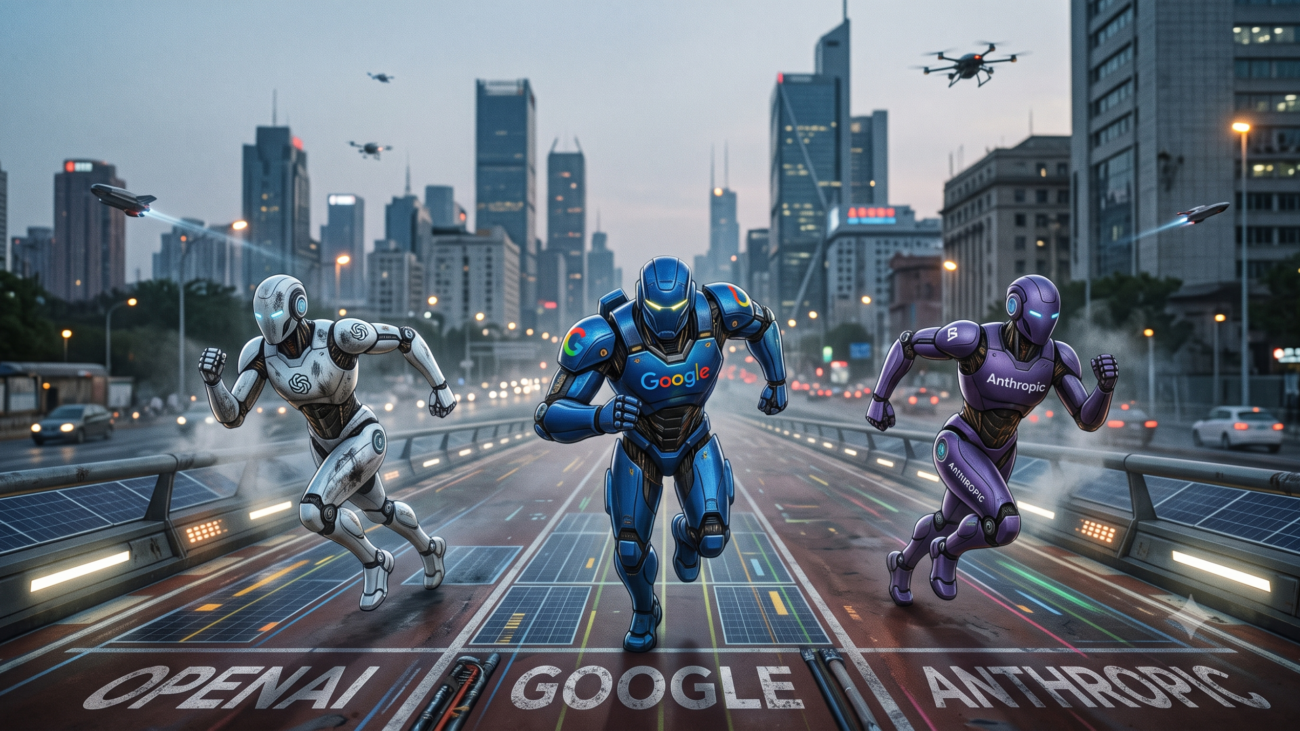
Artificial Intelligence (AI) has become one of the most transformative technologies of the 21st century. From writing content and generating images to coding software and assisting scientific research, AI is changing how individuals and businesses operate. At the heart of this revolution are three major players: OpenAI, Google, and Anthropic. Each company is racing to build the most capable, safest, and commercially successful AI systems.
But how do these companies differ? Which one is leading the AI race? And what does this competition mean for businesses, developers, and everyday users?
Let’s explore the AI race in detail.
The Rise of Generative AI
The AI industry witnessed a massive breakthrough with the launch of ChatGPT in late 2022. Millions of users quickly adopted AI-powered chatbots, proving that large language models (LLMs) could become mainstream productivity tools.
Since then, technology companies have invested billions of dollars into AI research, infrastructure, and product development. Cloud providers, startups, and enterprises are now integrating AI into nearly every digital service.
Among all competitors, OpenAI, Google, and Anthropic have emerged as the most influential organizations shaping the future of AI.
OpenAI: The Innovation Leader
OpenAI transformed the AI industry with the introduction of ChatGPT, making advanced language models accessible to the public. Its GPT series has continually improved in reasoning, coding, writing, image understanding, and multimodal capabilities.
Key Strengths
- Exceptional conversational AI
- Strong coding assistance
- Multimodal capabilities (text, images, voice)
- Extensive developer ecosystem
- Popular AI APIs for businesses
OpenAI focuses heavily on usability. Businesses use its models for customer support, automation, content generation, software development, education, and research.
Its partnership with Microsoft has further accelerated enterprise adoption through cloud integration and productivity tools.
Weaknesses
Despite its strengths, OpenAI faces challenges such as:
- High infrastructure costs
- Increasing competition
- Regulatory scrutiny
- Balancing innovation with AI safety
Nevertheless, OpenAI remains one of the most recognizable names in artificial intelligence.
Google: The AI Giant
Google has been investing in AI for over a decade. Technologies like TensorFlow, Google Translate, Google Assistant, and DeepMind laid the foundation long before generative AI became popular.
Today, Google has integrated AI across its ecosystem, including:
- Search
- Gmail
- Google Docs
- Android
- Workspace
- Cloud Platform
Its Gemini family of AI models powers many of these services.
Key Strengths
- Massive computing infrastructure
- World-leading AI research
- Huge user base
- Deep integration across Google products
- Advanced multimodal capabilities
Google’s biggest advantage is scale. Billions of users already rely on Google products daily, making AI adoption relatively seamless.
Challenges
Google also faces unique difficulties:
- Protecting search revenue
- Avoiding misinformation in AI-generated answers
- Competition from faster-moving startups
- Regulatory concerns worldwide
Despite these challenges, Google remains one of the strongest contenders in the AI race.
Anthropic: The Safety-First Challenger
Anthropic is a relatively young AI company founded by former OpenAI researchers. While it may not have Google’s size or OpenAI’s brand recognition, it has quickly established itself as a serious competitor.
Its flagship AI assistant, Claude, is known for:
- Helpful conversations
- Long-context understanding
- Reliable document analysis
- Strong emphasis on AI safety
Anthropic’s philosophy centers around building AI systems that are helpful, honest, and harmless.
Key Strengths
- Excellent long-document processing
- Strong reasoning abilities
- Enterprise-focused solutions
- AI safety research
- Constitutional AI methodology
Many businesses prefer Claude for handling lengthy reports, legal documents, research papers, and business workflows.
Challenges
Anthropic still faces obstacles such as:
- Smaller market share
- Limited consumer visibility
- Heavy competition
- Dependence on cloud partnerships
Even so, it has become one of the fastest-growing AI startups.
Feature Comparison
| Feature | OpenAI | Anthropic | |
|---|---|---|---|
| Chat Experience | Excellent | Excellent | Excellent |
| Coding Assistance | Outstanding | Very Good | Very Good |
| Long Context | Strong | Strong | Excellent |
| Search Integration | Limited | Outstanding | Limited |
| Enterprise Adoption | High | High | Growing |
| AI Safety | High | High | Very High |
| Research Leadership | Excellent | Excellent | Excellent |
| Consumer Ecosystem | Strong | Massive | Moderate |
How Their AI Strategies Differ
Although all three companies build advanced language models, their strategies are quite different.
OpenAI
OpenAI focuses on creating general-purpose AI assistants that help individuals and businesses across countless tasks. It prioritizes rapid innovation and developer accessibility.
Google aims to integrate AI into every product within its ecosystem. Instead of building standalone AI tools alone, it embeds intelligence into search, productivity software, smartphones, and cloud services.
Anthropic
Anthropic prioritizes responsible AI development. Its models emphasize reliability, transparency, and safety, particularly for enterprise applications where trust is essential.
The Battle for Enterprise AI
The next phase of the AI race extends beyond consumer chatbots.
Large enterprises are investing heavily in AI-powered automation for:
- Customer service
- Software development
- Marketing
- Healthcare
- Finance
- Legal research
- Manufacturing
Each company offers enterprise-grade AI solutions with different strengths.
OpenAI provides flexible APIs and developer tools.
Google leverages its cloud infrastructure and Workspace ecosystem.
Anthropic focuses on secure, reliable AI suitable for regulated industries.
This enterprise market is expected to generate hundreds of billions of dollars over the coming decade.
AI Safety Becomes a Competitive Advantage
As AI systems become more capable, safety has become one of the industry’s biggest priorities.
Major concerns include:
- Hallucinated information
- Privacy protection
- Bias
- Copyright issues
- Cybersecurity risks
- Responsible deployment
Anthropic has built its reputation around safety-first development.
OpenAI continues investing heavily in alignment research and responsible deployment.
Google combines decades of AI research with extensive content moderation systems.
Future AI leaders will likely be judged not only by intelligence but also by reliability and trustworthiness.
Who Is Winning the AI Race?
There is no single winner because each company excels in different areas.
- OpenAI leads in consumer adoption, conversational AI, and developer tools.
- Google dominates infrastructure, search integration, and ecosystem reach.
- Anthropic stands out for safety, long-context reasoning, and enterprise trust.
Rather than one company replacing the others, the future AI landscape is likely to remain competitive, with each organization specializing in different strengths.
What This Means for Users
For individuals, this competition means smarter AI assistants, better productivity tools, and faster innovation.
For developers, it offers more choices in AI APIs and platforms.
For businesses, competition drives better pricing, improved features, and more specialized AI solutions.
Ultimately, users benefit as companies race to build faster, safer, and more capable AI systems.
Conclusion
The competition between OpenAI, Google, and Anthropic is reshaping the future of technology. While OpenAI continues to innovate with powerful conversational AI, Google leverages its massive ecosystem to integrate AI into everyday products. Meanwhile, Anthropic is carving out a strong position by emphasizing AI safety and enterprise reliability.
As AI continues to evolve, the rivalry among these three organizations will influence everything from education and healthcare to software development and scientific discovery. Rather than asking which company will win, a better question may be how their competition will accelerate innovation for everyone.
The AI race has only just begun—and its impact will be felt across every industry in the years ahead.

Leave A Comment