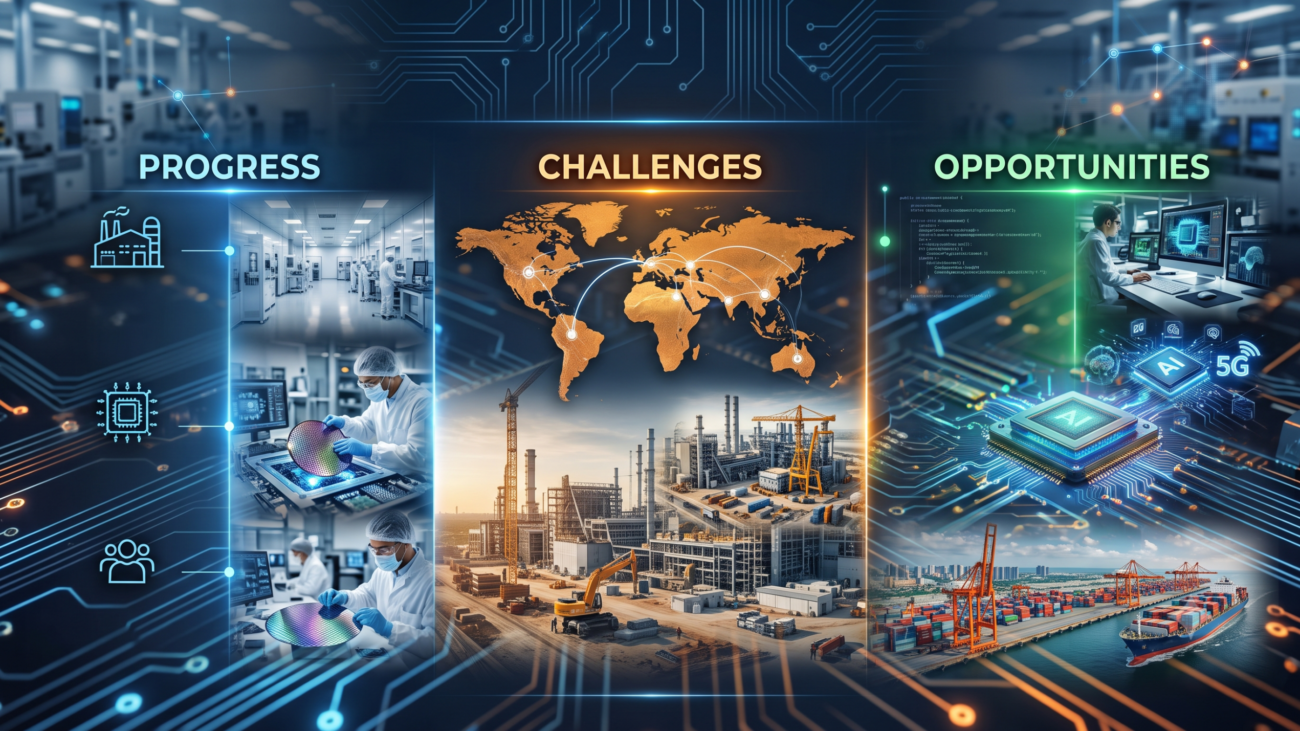
Semiconductors have become the backbone of the modern digital economy. From smartphones and laptops to electric vehicles, defense systems, artificial intelligence (AI), and healthcare devices, semiconductor chips power almost every aspect of our daily lives. As global demand for chips continues to rise, countries are investing heavily in developing their domestic semiconductor industries. India has also entered this race through its ambitious India Semiconductor Mission (ISM), aiming to transform the country into a global semiconductor manufacturing hub.
The mission represents more than just industrial growth—it is a strategic initiative focused on technological self-reliance, economic development, national security, and job creation. While India has made significant progress in attracting investments and policy reforms, several challenges remain before it can compete with established semiconductor giants such as Taiwan, South Korea, and the United States.
In this blog, we explore India’s Semiconductor Mission, its achievements, challenges, and the immense opportunities it presents for the country’s future.
Understanding India’s Semiconductor Mission
The India Semiconductor Mission (ISM) was launched by the Government of India in 2021 under the Ministry of Electronics and Information Technology (MeitY). The mission aims to build a sustainable semiconductor and display manufacturing ecosystem by providing financial incentives, infrastructure support, and policy assistance to global and domestic companies.
The government announced a financial package worth ₹76,000 crore to encourage investments in semiconductor fabrication (fabs), display manufacturing, chip packaging, testing, and design.
The primary objectives of the mission include:
- Developing semiconductor fabrication facilities in India
- Promoting semiconductor design and innovation
- Reducing dependence on imported chips
- Strengthening India’s electronics manufacturing ecosystem
- Creating high-skilled employment opportunities
- Enhancing national technological security
Why Semiconductors Matter
Modern economies rely heavily on semiconductor chips. They are essential components in:
- Smartphones and tablets
- Computers and servers
- Electric vehicles (EVs)
- Medical equipment
- Defense systems
- Space technology
- Artificial Intelligence applications
- Internet of Things (IoT) devices
- 5G and future communication technologies
The global semiconductor shortage during the COVID-19 pandemic exposed vulnerabilities in supply chains worldwide. Countries realized that dependence on a handful of manufacturing hubs could significantly impact industries ranging from automotive to consumer electronics.
India’s Semiconductor Mission is therefore both an economic and strategic necessity.
Progress Made So Far
India has made encouraging progress since launching the mission.
1. Major Investment Announcements
Several global companies have announced semiconductor-related investments in India.
Companies involved in fabrication, assembly, testing, packaging (ATMP), and design have shown increasing interest due to government incentives and India’s growing electronics market.
These investments are expected to establish India’s first commercial semiconductor manufacturing ecosystem.
2. Growing Electronics Manufacturing
India has already become one of the world’s largest smartphone manufacturing hubs.
The success of initiatives like:
- Make in India
- Digital India
- Production Linked Incentive (PLI) Scheme
has created strong demand for locally manufactured semiconductor components.
3. Increasing Design Capabilities
Interestingly, India already has a strong semiconductor design ecosystem.
Many global companies including Intel, Qualcomm, AMD, NVIDIA, Texas Instruments, and Synopsys operate large design centers in India.
Indian engineers contribute significantly to global chip design, verification, software development, and embedded systems.
The next step is converting design expertise into manufacturing capabilities.
4. Government Policy Support
The government has simplified approval processes and introduced attractive incentives including:
- Capital subsidies
- Tax benefits
- Infrastructure support
- Faster approvals
- Long-term policy commitments
These reforms improve investor confidence.
Challenges Facing India’s Semiconductor Mission
Despite promising developments, semiconductor manufacturing remains one of the world’s most complex industries.
1. Extremely High Capital Investment
Building a semiconductor fabrication plant can cost anywhere between $5 billion and $20 billion, depending on technology.
Maintaining competitiveness also requires continuous upgrades every few years.
This makes semiconductor manufacturing one of the most capital-intensive industries globally.
2. Technology Gap
Leading semiconductor manufacturers currently produce chips using advanced technologies such as:
- 3nm
- 2nm
- 5nm
India is still at the beginning of establishing commercial fabrication facilities.
Bridging this technology gap requires partnerships with global technology leaders.
3. Skilled Workforce Requirements
Although India has a large engineering workforce, semiconductor manufacturing requires highly specialized skills in:
- Materials science
- Chemical engineering
- Nanotechnology
- Process engineering
- Equipment maintenance
- Chip fabrication
Universities and industries must work together to develop specialized talent.
4. Supply Chain Development
A semiconductor ecosystem requires much more than fabrication plants.
It also depends on suppliers of:
- Silicon wafers
- Specialty chemicals
- Industrial gases
- Precision equipment
- Clean room technology
- Packaging materials
India must build an integrated semiconductor supply chain.
5. Infrastructure Challenges
Semiconductor fabs require:
- Uninterrupted electricity
- Ultra-pure water
- Reliable logistics
- Advanced transportation
- Stable environmental conditions
Any interruption can result in significant production losses.
Developing this infrastructure remains a major priority.
Opportunities for India
Despite these challenges, India’s long-term opportunities are enormous.
Becoming a Global Manufacturing Hub
As companies seek to diversify their manufacturing beyond traditional locations, India has the opportunity to become a trusted semiconductor manufacturing destination.
The global trend toward supply chain diversification works in India’s favor.
Employment Generation
The semiconductor industry creates employment across multiple sectors including:
- Manufacturing
- Research
- Design
- Testing
- Packaging
- Equipment maintenance
- Logistics
- Software development
Experts estimate that the industry could generate hundreds of thousands of direct and indirect jobs in the coming years.
Boost to Electronics Industry
Domestic chip manufacturing can significantly strengthen India’s electronics ecosystem.
Industries such as:
- Consumer electronics
- Automotive
- Telecom
- Healthcare
- Defense
- Renewable energy
would benefit from improved supply security and reduced import dependence.
Encouraging Innovation
India’s startup ecosystem can also benefit.
Semiconductor availability encourages innovation in:
- Artificial Intelligence
- Robotics
- Internet of Things
- Smart manufacturing
- Autonomous vehicles
- Medical technology
Greater access to chip manufacturing could accelerate India’s deep-tech startup ecosystem.
National Security
Semiconductors play a critical role in defense equipment, communication systems, satellites, and cybersecurity.
Domestic manufacturing reduces strategic vulnerabilities and strengthens national security.
Global Partnerships
India is actively collaborating with several countries to strengthen semiconductor cooperation.
Strategic partnerships with nations such as the United States, Japan, Singapore, and European countries focus on:
- Technology transfer
- Research collaboration
- Supply chain resilience
- Investment promotion
- Skill development
Such collaborations are expected to accelerate India’s semiconductor ambitions.
The Road Ahead
India’s semiconductor journey is only beginning.
Success will depend on sustained government support, industry participation, skilled workforce development, research investment, and strong global partnerships.
Building a complete semiconductor ecosystem may take years, but the foundation has already been laid. With consistent policy implementation and long-term investment, India can become a major player in the global semiconductor value chain.
The mission aligns perfectly with India’s broader vision of becoming a global manufacturing powerhouse while strengthening technological independence and economic resilience.
Conclusion
India’s Semiconductor Mission represents one of the country’s most significant industrial initiatives in recent decades. Although challenges such as high capital costs, technology gaps, infrastructure requirements, and supply chain development remain substantial, the opportunities far outweigh the obstacles.
With strong government backing, growing private-sector investment, an expanding electronics market, and a talented engineering workforce, India is well-positioned to emerge as a key contributor to the global semiconductor industry. The journey will require patience, innovation, and collaboration, but the potential rewards include economic growth, technological leadership, job creation, and enhanced national security.
As the global demand for semiconductor chips continues to rise, India’s efforts today could shape its position as a leading technology and manufacturing hub for decades to come.

Leave A Comment