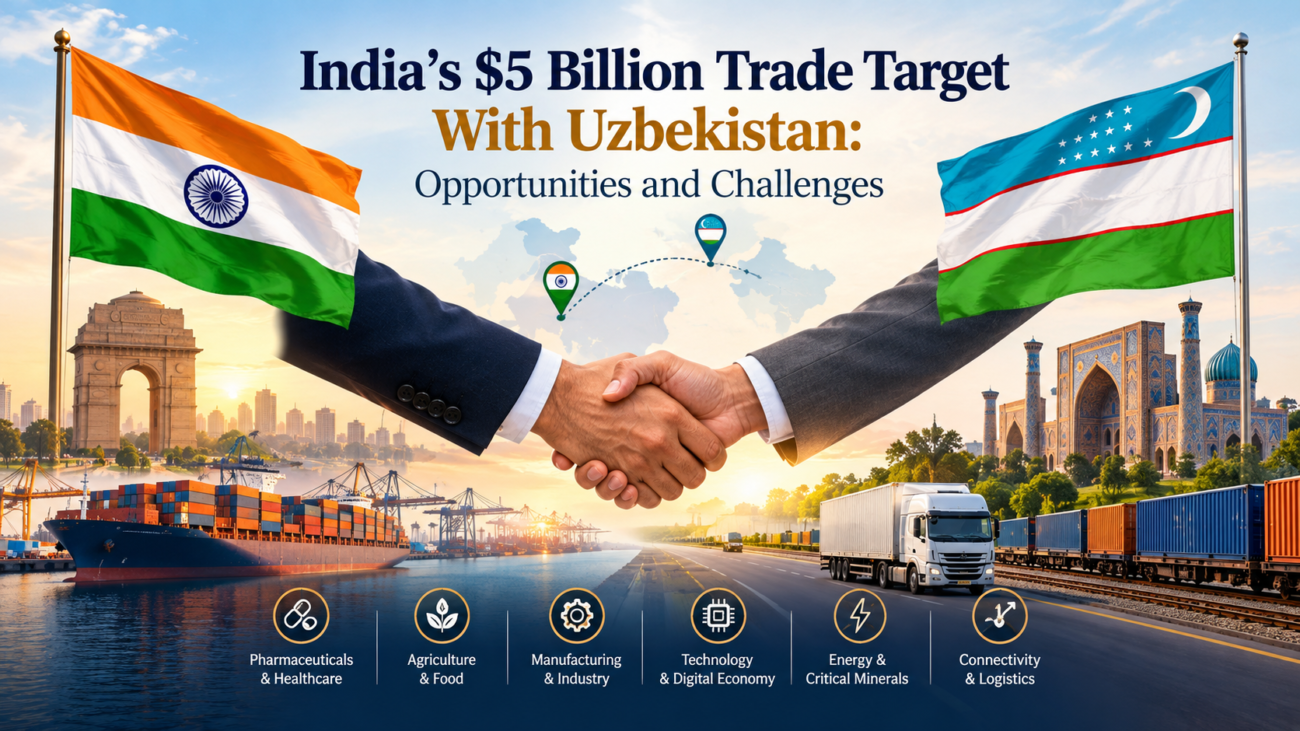
India and Uzbekistan are entering an important new phase in their economic relationship, with both countries setting an ambitious target of increasing bilateral trade to $5 billion by 2030.
The target represents a major expansion from current trade levels and reflects a broader effort to strengthen India’s economic presence in Central Asia. For India, Uzbekistan offers a growing market, a strategically important location and opportunities across pharmaceuticals, healthcare, agriculture, technology, manufacturing, energy and critical minerals. But reaching $5 billion will not be easy. The two countries must overcome geographical constraints, high transportation costs, regulatory barriers and limited connectivity. The success of the target will therefore depend not only on increasing exports, but also on creating stronger investment partnerships and more efficient trade routes.Why Uzbekistan Matters to India
Uzbekistan is one of Central Asia’s most important economies and occupies a strategically significant position at the crossroads of major regional markets. For India, stronger economic engagement with Uzbekistan supports its wider effort to deepen ties with Central Asia. The relationship is no longer limited to traditional diplomatic cooperation; trade, investment, technology and resource security are becoming increasingly important.Expanding Market Access
India can use Uzbekistan as an important gateway for expanding its commercial presence across Central Asia, particularly in pharmaceuticals, healthcare, technology and consumer goods.
Regional Economic Potential
Uzbekistan offers Indian businesses access to a young and developing market while providing opportunities for manufacturing, investment and regional supply-chain partnerships.
“The $5 billion target will require India and Uzbekistan to move from traditional trade toward deeper investment and production partnerships.”
The economic opportunityPharmaceuticals Could Lead the Expansion
India’s pharmaceutical industry is one of the strongest areas of potential cooperation with Uzbekistan. Indian companies have established global capabilities in producing affordable medicines, generic drugs and healthcare products. Uzbekistan, meanwhile, has significant healthcare requirements and opportunities for modernising its pharmaceutical ecosystem. The next stage could involve more than exports. Indian pharmaceutical companies can explore local manufacturing, joint ventures, research partnerships and distribution networks in Uzbekistan.From exporting medicines to building healthcare partnerships.
Long-term manufacturing and investment partnerships could help Indian companies establish a stronger presence in Uzbekistan while supporting the country’s healthcare and pharmaceutical development.
Where the Biggest Opportunities Lie
The $5 billion trade ambition will require multiple sectors to contribute. Pharmaceuticals may be important, but agriculture, technology, manufacturing, energy and critical minerals can significantly expand the relationship.Trade Alone Will Not Be Enough
One of the most important questions surrounding the $5 billion target is how both countries define the future of their economic relationship. Simply increasing the shipment of goods may not be sufficient. Investment can create a much stronger and more sustainable economic connection. Indian businesses can consider establishing manufacturing facilities in Uzbekistan, while Uzbek companies can explore opportunities in India’s large consumer and industrial markets.Geography Remains a Major Obstacle
India and Uzbekistan face a fundamental geographical challenge: Uzbekistan is landlocked, while India does not have a direct overland trade route through Pakistan. This makes transportation more complicated and can increase logistics costs, transit times and uncertainty for businesses. Alternative connectivity routes are therefore critical to the success of the $5 billion target. The International North-South Transport Corridor and India’s engagement with Chabahar Port can provide potential routes for improving India’s access to Central Asia.“A larger trade relationship requires not only more products, but faster, cheaper and more predictable ways to move them.”
The connectivity challengeRegulations Could Slow the Target
Transportation is not the only challenge. Differences in product standards, certification requirements, customs procedures, documentation and business regulations can create barriers for companies entering the Uzbek market. These issues can be particularly difficult for small and medium-sized businesses that lack the resources of large multinational corporations. India and Uzbekistan will therefore need to continue working toward simpler procedures and greater transparency.Make cross-border business easier.
Reducing regulatory friction can encourage more companies to participate in bilateral trade and make the $5 billion target more achievable.
Technology Can Create a New Trade Corridor
Physical goods are only one part of the future India-Uzbekistan relationship. India’s digital economy provides opportunities in software development, fintech, cybersecurity, digital payments, education technology and business services. Digital cooperation could also help smaller businesses participate in international commerce. If payment systems, business platforms and digital customs processes become more integrated, companies could potentially conduct cross-border business faster and with lower transaction costs. This makes the digital economy an important complement to physical connectivity.Can India Reach the $5 Billion Target?
The target is ambitious, but its achievement will depend on whether both countries can turn political commitments into practical business opportunities.More Than a Trade Target
The $5 billion objective should be viewed as part of India’s broader engagement with Central Asia. A stronger economic relationship with Uzbekistan can support India’s ambitions in areas ranging from critical minerals and energy security to pharmaceuticals, technology and regional connectivity. For Uzbekistan, deeper economic cooperation with India can bring investment, technology and access to one of the world’s largest consumer markets. For both countries, the relationship offers an opportunity to diversify economic partnerships in a rapidly changing global economy.“The real value of the $5 billion target may lie not in the number itself, but in the economic ecosystem created to reach it.”
The bigger pictureIndia and Uzbekistan’s Next Economic Chapter
India’s $5 billion trade target with Uzbekistan represents an ambitious attempt to transform bilateral economic relations. The opportunities are significant. Pharmaceuticals, healthcare, agriculture, technology, manufacturing, critical minerals and energy can all contribute to stronger commercial ties. But ambition alone will not achieve the target. India and Uzbekistan must address connectivity problems, reduce regulatory barriers, encourage investment and create stronger private-sector partnerships. If these challenges are addressed effectively, the relationship could develop far beyond a conventional buyer-and-seller model.The real opportunity is not simply to reach $5 billion in trade — it is to build a lasting India–Uzbekistan economic partnership that can shape India’s wider engagement with Central Asia.

Leave A Comment