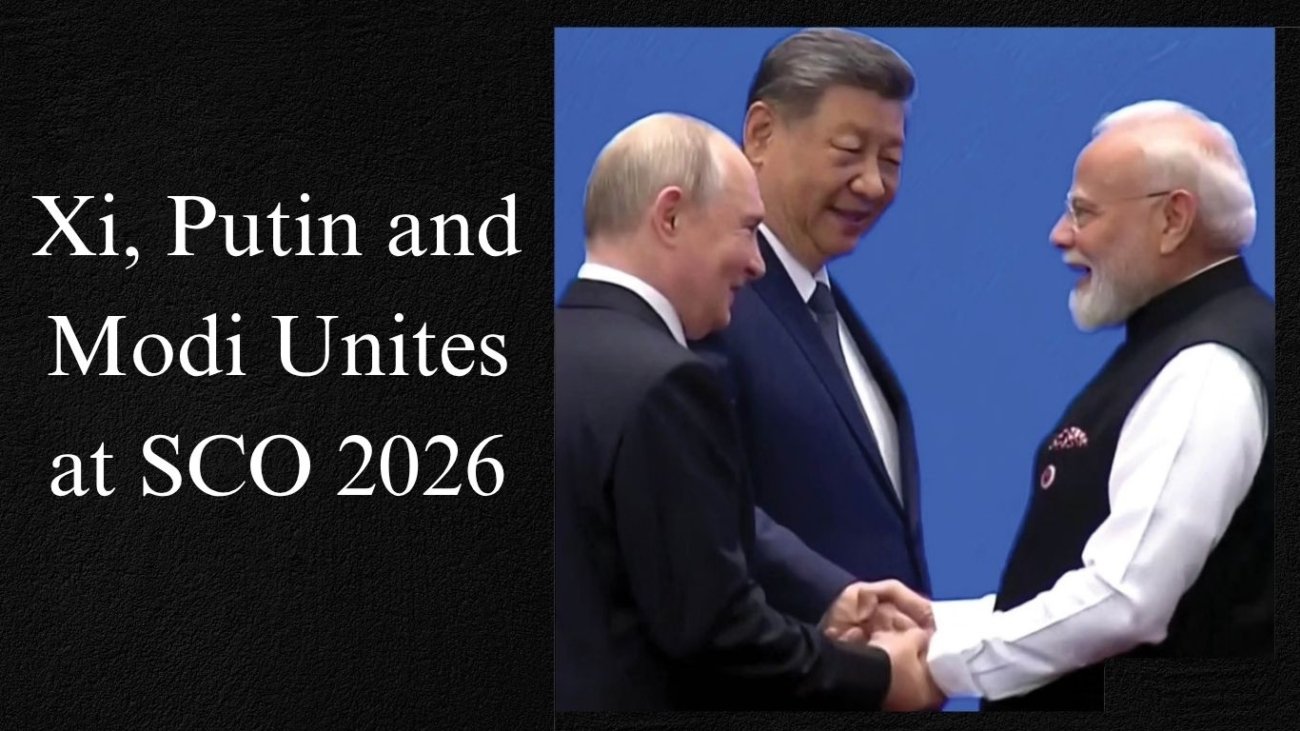
The image of Narendra Modi with Xi Jinping and Vladimir Putin at the Shanghai Cooperation Organisation summit in Bishkek carries a significance that extends well beyond the symbolism of three major powers standing together.
India, China and Russia are not allies. They do not share the same strategic interests, political systems or vision of the international order. Yet their leaders increasingly find themselves in the same diplomatic room at a time when the global balance of power is undergoing a profound transformation.
The important question, therefore, is not whether Modi, Xi and Putin are creating a new alliance. They are not.
The more important question is whether India is helping shape a world in which no single power can dominate the international system.
Modi and Xi: Engagement Without Illusion
The interaction between Modi and Xi Jinping is perhaps the most strategically significant relationship in the entire picture.
India and China remain competitors. The border dispute has created deep strategic mistrust, while both countries are competing for influence across Asia, the Indian Ocean and the developing world.
But competition does not automatically require permanent confrontation.
Strategic Autonomy
India wants enough strategic freedom to work with the United States, Europe, Russia, Japan, the Gulf and other powers without becoming dependent on any single bloc.
Managed Competition
Beijing remains India’s principal strategic competitor, but stable communication can reduce the risk that competition turns into uncontrolled escalation.
This is the logic behind India’s approach: compete where necessary, cooperate where useful and communicate where stability requires it.
“India does not need to choose between Washington and Beijing. It needs enough power to negotiate with both.”
Strategic logicModi and Putin: A Partnership in Transition
India’s relationship with Russia is fundamentally different from its relationship with China.
Russia has been one of India’s most important strategic partners for decades, particularly in defence, energy, nuclear cooperation and diplomatic affairs.
But the relationship is changing.
Russia’s deepening relationship with China, the war in Ukraine and India’s expanding relationship with the United States have created a much more complicated strategic environment.
India therefore has to maintain its relationship with Moscow without allowing that relationship to define its entire foreign policy.
Friendship does not mean alignment.
India can maintain historic relationships while simultaneously building new partnerships with other major powers.
Why the Modi–Xi–Putin Image Matters
A photograph can sometimes reveal the direction of international politics more clearly than a diplomatic communiqué.
The presence of Modi, Xi and Putin together demonstrates that the global system is becoming increasingly fragmented, but also increasingly interconnected.
From a Bipolar World to a Multipolar One
For much of the twentieth century, international politics was dominated by a relatively simple structure: the United States and its allies on one side, and the Soviet Union and its allies on the other.
The post-Cold War period temporarily created an American-led unipolar system.
That era is now being challenged.
China has become an economic superpower. India is rapidly expanding its economic and geopolitical weight. Russia remains a major military and energy power. Middle Eastern countries are pursuing increasingly independent foreign policies, while countries across Africa, Asia and Latin America are demanding a greater role in global decision-making.
“The emerging world order may not be East versus West. It may be everyone negotiating with everyone.”
The multipolar argumentIndia Wants Leverage, Not Loyalty
This is where India’s strategy becomes particularly interesting.
New Delhi has simultaneously strengthened the Quad and its relationship with the United States, maintained defence and energy ties with Russia, managed its complex relationship with China, expanded engagement with Europe and deepened strategic partnerships with Gulf countries.
At first glance, these relationships can appear contradictory.
From India’s perspective, however, they are complementary.
- With the United States: technology, defence, investment and strategic cooperation.
- With Russia: defence, energy and long-standing strategic ties.
- With Europe: trade, technology and investment.
- With China: economic engagement combined with strategic competition.
- With the Global South: diplomatic influence and leadership on development issues.
The underlying principle is simple: India wants to maximise its options.
This Is Not a China–Russia–India Alliance
It would be a mistake to interpret the Modi–Xi–Putin interaction as the birth of an anti-Western bloc.
India has no strategic interest in replacing one dominant bloc with another.
India’s objective is fundamentally different: create enough economic, military and diplomatic capability that it can make decisions independently.
Non-alignment was about staying out.
Strategic autonomy is about having the power to engage with everyone while remaining free to choose.
A More Transactional International System
The most important consequence of this emerging multipolarity may be the decline of permanent geopolitical camps.
Countries may increasingly cooperate on one issue while competing on another.
India can cooperate with the United States on technology and defence while purchasing energy from Russia. It can compete with China in the Indo-Pacific while participating in institutions where both countries are members.
This is messy diplomacy—but it may become the defining feature of the twenty-first century.
The future international system may therefore be less about choosing sides and more about managing relationships.
India’s Moment in a Changing World
The significance of Modi’s interactions with Xi and Putin is not that India has joined a new geopolitical camp.
It is almost the opposite.
India is demonstrating that a rising power can maintain relationships with competing centres of power while pursuing its own national interests.
If the twenty-first century is indeed moving toward a multipolar world, India’s greatest strategic asset may not be choosing the right side.
It may be having the power to work with everyone—and remain subordinate to no one.

Leave A Comment