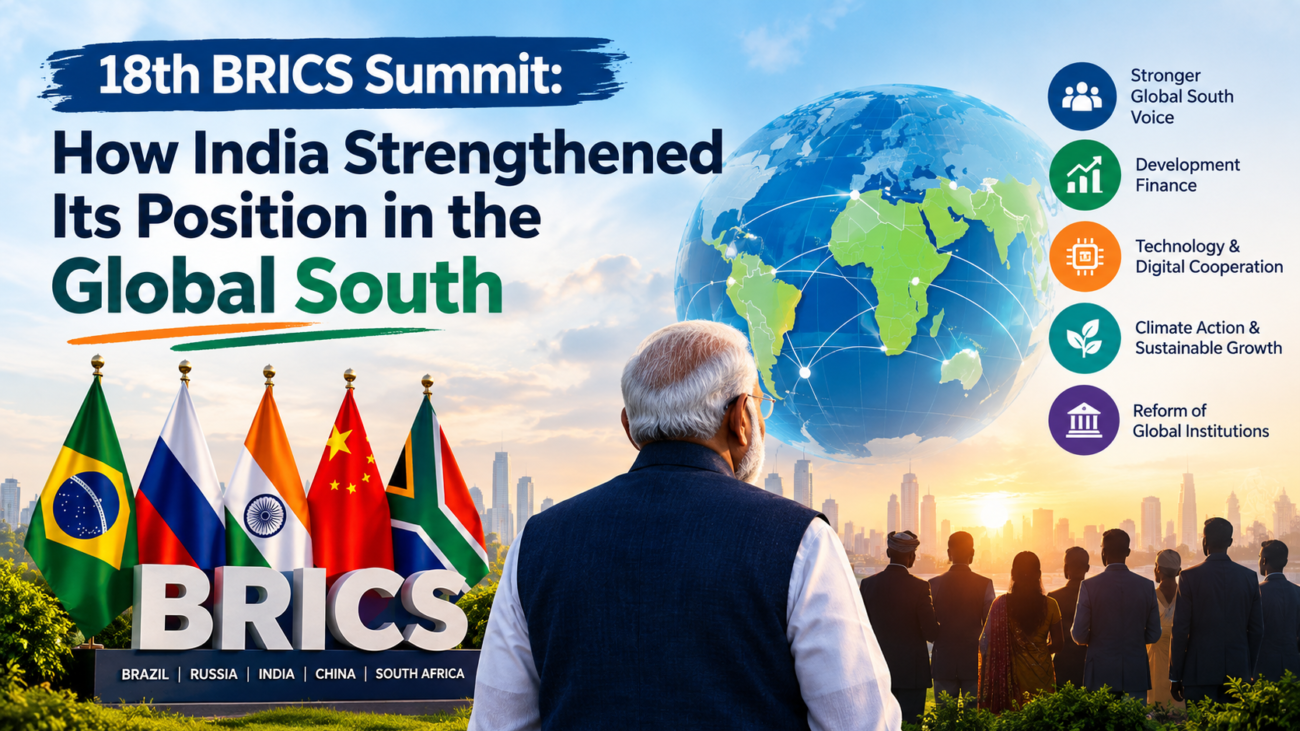
India’s leadership of the 18th BRICS Summit has strengthened its position as an important voice of the Global South, with New Delhi using the expanded grouping to push for more inclusive global governance, practical economic cooperation and development-focused international partnerships.
The 18th BRICS Summit was held in New Delhi on 12–13 September 2026 under India’s chairship and the theme “Building for Resilience, Innovation, Cooperation and Sustainability.” The summit concluded with the adoption of the New Delhi Declaration, reaffirming cooperation across political and security, economic and financial, and cultural and people-to-people pillars. For India, the summit was more than a diplomatic gathering. It was an opportunity to demonstrate that the Global South can play a greater role in shaping international rules, institutions and development priorities.India’s Growing Voice in the Global South
India has increasingly positioned itself as a bridge between developed economies and emerging and developing countries. BRICS provides an important platform for advancing this role because its expanded membership brings together major economies from Asia, Africa and other regions of the developing world. During its 2026 chairship, India placed strong emphasis on development-oriented cooperation and wider participation by emerging markets and developing countries. The New Delhi Declaration specifically welcomed stronger engagement with Emerging Markets and Developing Countries and highlighted inclusive, mutually beneficial partnerships.From Voice to Rule-Shaper
India is seeking a greater role for developing countries in shaping global rules rather than simply responding to decisions made by established powers.
Greater Representation
BRICS gives emerging economies a platform to advocate reforms in global governance, finance, trade, technology and sustainable development.
“India’s BRICS leadership strengthened its case for a more representative and inclusive global order.”
India and the Global SouthPush for a More Representative Global Order
One of India’s central priorities has been reform of international institutions so that their structures better reflect today’s economic and demographic realities. The New Delhi Declaration reaffirmed the need for a more representative and fairer international order and a reformed multilateral system. It also recognised BRICS’ growing influence as a platform for inclusive global governance. For India, this strengthens a long-standing diplomatic argument: countries representing large populations and significant portions of the global economy should have a stronger voice in institutions responsible for international decision-making.The Global South should help shape the rules of the international system.
India’s approach focuses on strengthening multilateral institutions while giving developing and emerging economies greater representation in global decision-making.
Building Greater Economic Resilience
Economic cooperation was another important element of India’s BRICS chairship. The New Delhi Declaration supported stronger trade and investment cooperation, greater use of local currencies in cross-border transactions and continued work toward improving payment-system interoperability. BRICS also encouraged the New Development Bank to expand local-currency financing. Rather than pursuing an immediate common BRICS currency, the grouping adopted a more gradual approach to financial cooperation. This reflects India’s preference for practical mechanisms that can reduce transaction barriers without creating unnecessary economic or institutional risks.Putting Technology at the Centre of Global South Development
Technology emerged as another important area where India used its chairship to promote cooperation among developing economies. The summit backed initiatives involving digital public infrastructure, artificial intelligence, Industry 4.0 and digital knowledge-sharing. India also promoted greater attention to safe, inclusive and equitable access to artificial intelligence for countries of the Global South. India’s experience with digital public infrastructure gives it an opportunity to share technological models with other developing countries.- Digital Public Infrastructure: Encouraging knowledge-sharing and cooperation around digital systems.
- Artificial Intelligence: Supporting safe, inclusive and equitable access to AI technologies.
- Industry 4.0: Promoting cooperation in advanced manufacturing and industrial innovation.
- Digital Skills: Supporting capacity-building and technology-related education across BRICS countries.
Making BRICS More People-Centred
India’s 2026 chairship placed considerable emphasis on connecting BRICS cooperation with ordinary citizens. According to India’s official description of the chairship, more than 350 meetings and high-level engagements were organised across multiple Indian cities during the year, covering areas including health, education, agriculture, energy, technology, environment, youth and culture. This broad agenda helped India present BRICS not simply as a geopolitical grouping but as a platform capable of producing practical development outcomes.“The strength of BRICS will increasingly depend on how effectively cooperation improves opportunities and resilience for ordinary people.”
People-centred BRICS cooperationConnecting Growth With Climate Responsibility
Climate change and sustainable development are major concerns for countries across the Global South. Developing economies need access to finance, technology and infrastructure that can support economic growth while reducing environmental risks. India’s BRICS chairship placed sustainability alongside resilience, innovation and cooperation as a central priority. The New Delhi Declaration reaffirmed BRICS’ commitment to sustainable development and inclusive growth, strengthening India’s effort to connect climate priorities with the broader development agenda. For India, this approach is particularly important because it allows the country to advocate climate action while also highlighting the development needs of emerging economies.Balancing Different Powers Through Dialogue
The expanded BRICS grouping contains countries with very different strategic interests. Managing these differences is one of the biggest challenges facing the organisation. India’s chairship demonstrated its ability to maintain dialogue across these differences. During the summit, Prime Minister Narendra Modi held important bilateral discussions with leaders including Chinese President Xi Jinping, Russian President Vladimir Putin and Iranian President Masoud Pezeshkian. This reflects India’s broader diplomatic approach of maintaining strategic autonomy while engaging with multiple major powers.Engage widely without becoming dependent on a single power centre.
India’s ability to communicate with different geopolitical blocs gives it additional space to represent the interests of emerging and developing countries.
Can BRICS Turn Influence Into Action?
The summit strengthened India’s diplomatic position, but influence will ultimately depend on implementation. BRICS includes countries with different economic systems, strategic priorities and positions on international conflicts. Maintaining consensus while producing practical outcomes will therefore remain a major challenge.- Implement financial initiatives: Turn proposals on local-currency financing and payment cooperation into practical mechanisms.
- Strengthen trade: Reduce barriers and improve economic integration among members.
- Expand development cooperation: Ensure BRICS initiatives benefit emerging and developing economies.
- Improve technological access: Help Global South countries participate in the AI and digital economy.
- Maintain consensus: Balance the different strategic interests of an increasingly diverse membership.
India’s Global South Moment
The 18th BRICS Summit represents an important moment in India’s evolution as a major voice of the Global South. India used its chairship to promote inclusive global governance, development finance, technology cooperation, sustainability and stronger engagement with emerging and developing countries. The adoption of the New Delhi Declaration also demonstrated that the expanded BRICS grouping could maintain a common framework despite significant differences among its members. For India, the significance goes beyond the summit itself. Its BRICS leadership strengthens its broader diplomatic strategy of building partnerships across Asia, Africa, Latin America and other developing regions while simultaneously engaging major developed economies.“India’s BRICS leadership was not simply about hosting a summit; it was about demonstrating that the Global South can become a stronger participant in shaping the global order.”
The bigger pictureIndia’s Stronger Position in the Global South
The 18th BRICS Summit provided India with an important platform to strengthen its diplomatic and economic position among emerging and developing nations. By focusing on inclusive global governance, economic cooperation, digital technology, sustainable development and development-oriented partnerships, India demonstrated its ambition to move beyond being a participant in the Global South and become one of its leading voices. The summit also showed India’s ability to manage a diverse grouping while maintaining dialogue with countries that have different strategic interests. The next challenge will be implementation. If BRICS can convert its declarations into stronger trade, financial cooperation, technology partnerships and development outcomes, India’s influence within the Global South is likely to grow further.The real significance of India’s 18th BRICS Summit leadership is that it strengthened India’s case to be not merely a voice of the Global South, but an active shaper of its future.

Leave A Comment