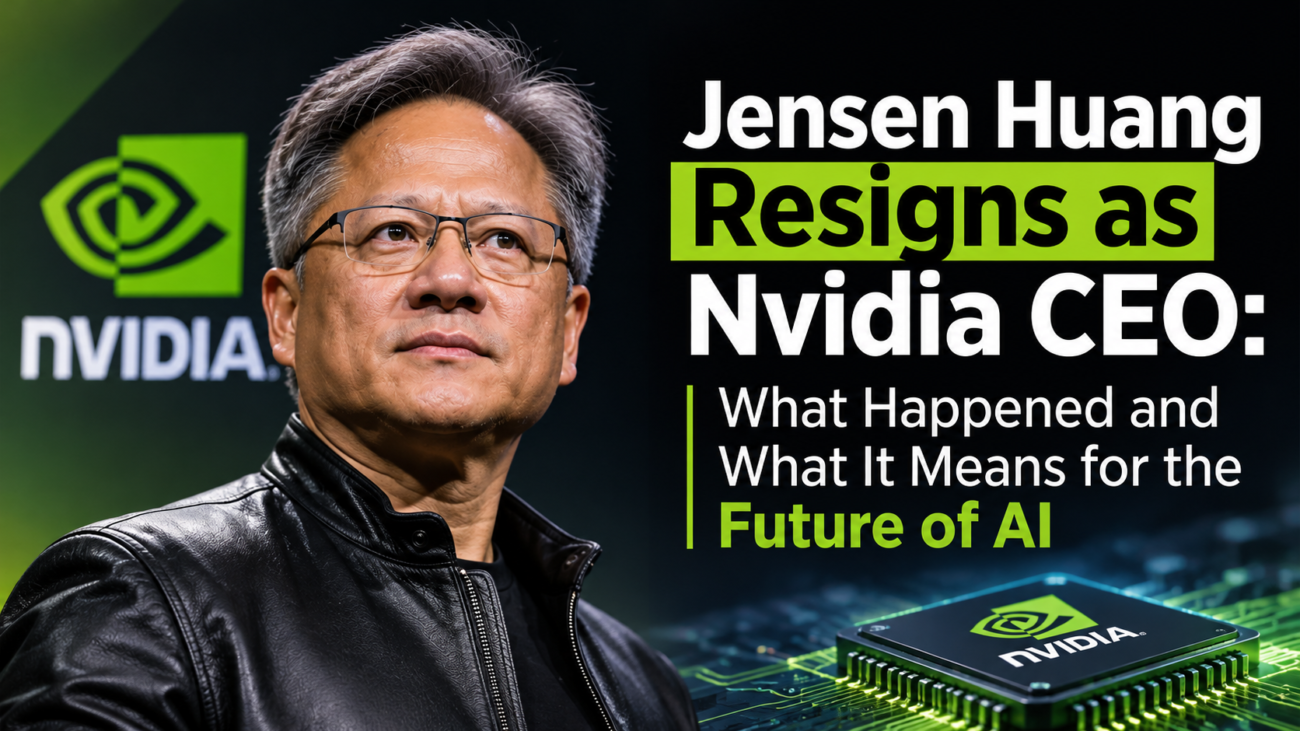
The artificial intelligence industry has been hit by a major leadership shake-up. Jensen Huang, the co-founder and longtime CEO of NVIDIA, has resigned from his position after more than three decades leading one of the world’s most influential technology companies.
The announcement, made on November 12, 2026, has attracted global attention because NVIDIA is at the centre of the AI revolution. Its graphics processing units (GPUs) power many of the world’s leading AI models, data centres and advanced computing systems.
Huang’s departure raises an important question: Can NVIDIA maintain its leadership in the global AI market without the person who built the company into an AI powerhouse?
The resignation has also attracted attention because of reports involving Huang’s personal relationships and potential national security concerns. These developments have added another layer of uncertainty to an already significant corporate leadership transition.
Let’s understand why Jensen Huang resigned, who will replace him, and what his departure could mean for NVIDIA and the future of artificial intelligence.
1. Why Did Jensen Huang Resign as NVIDIA CEO?
Jensen Huang’s resignation followed a period of intense scrutiny involving reports about his personal relationships and potential national security concerns.
Reports surfaced about an alleged relationship with Alice Huang, a Singapore-based businesswoman suspected by US officials of having links to Chinese intelligence. The allegations attracted particular attention because of NVIDIA’s strategic importance to the United States and its role in supplying advanced AI chips.
Huang also acknowledged an extramarital relationship, prompting further scrutiny of his personal conduct and leadership.
According to media reports, NVIDIA’s board considered the situation and its potential implications for the company. On November 12, NVIDIA announced that Huang had resigned as President, CEO and a member of its Board of Directors, effective immediately.
It is important to distinguish between reported allegations and established facts. Suspicion does not establish that someone has intelligence connections or has engaged in wrongdoing.
Importantly, NVIDIA’s official announcement did not provide a specific reason for Huang’s resignation. The connection between the reported controversies and the board’s decision comes from subsequent media reporting.
Jensen Huang’s departure is not simply a corporate leadership change. It marks a significant moment for one of the most influential companies powering the global AI revolution.
2. Who Will Replace Jensen Huang at NVIDIA?
Following Huang’s departure, NVIDIA appointed Colette Kress as interim CEO.
Kress has served as NVIDIA’s Executive Vice President and Chief Financial Officer since September 2013. She has played an important role in managing the company’s finances during its extraordinary expansion.
The board has also initiated a search for a permanent CEO and will consider both internal and external candidates.
Harvey C. Jones, a longtime NVIDIA director, has been appointed as the company’s first-ever chairman of the board.
Colette Kress
Interim CEO and CFO
She has been associated with NVIDIA since 2013 and will temporarily lead the company during the search for a permanent CEO.
Harvey C. Jones
Chairman of the Board
The longtime NVIDIA director has been appointed as the company’s first-ever chairman, helping oversee the leadership transition.
The leadership transition is particularly important because NVIDIA is managing enormous AI infrastructure investments, global partnerships and a rapidly evolving product roadmap.
The next permanent CEO will inherit responsibility for maintaining the company’s technological advantage while managing relationships with some of the world’s largest technology companies.
3. How Jensen Huang Built NVIDIA Into an AI Giant
To understand the significance of this resignation, it is important to understand Huang’s contribution to NVIDIA.
Founded in 1993 by Jensen Huang, Chris Malachowsky and Curtis Priem, NVIDIA initially focused on graphics processing technology, particularly for the gaming and computer graphics industries.
However, Huang recognised that GPUs could be used for much more than rendering images. Their ability to perform thousands of calculations simultaneously made them valuable for scientific computing, machine learning and artificial intelligence.
The CUDA Revolution
The introduction of CUDA in 2006 was a major turning point.
CUDA allowed developers to use NVIDIA GPUs for general-purpose computing, opening new opportunities beyond traditional graphics processing.
This decision helped establish a software ecosystem that encouraged researchers, developers and businesses to build applications using NVIDIA hardware.
The Rise of Generative AI
When AI research accelerated, NVIDIA was already positioned to supply much of the computing infrastructure required to train increasingly sophisticated models.
The arrival of generative AI and ChatGPT further accelerated demand for NVIDIA’s technology.
Companies developing large language models, AI assistants and advanced computing systems increasingly relied on powerful GPUs to train and operate their models.
Under Jensen Huang’s leadership, NVIDIA evolved from a graphics chip manufacturer into a central infrastructure provider for the global AI economy.
His ability to recognise the future importance of accelerated computing helped transform NVIDIA into one of the most influential companies in the technology industry.
4. What Does Jensen Huang’s Departure Mean for the AI Industry?
Huang’s resignation is not simply another CEO transition. It represents a significant change for an industry that has become heavily dependent on NVIDIA’s technology and strategic direction.
Here are four important areas to watch.
1. NVIDIA’s Future Leadership
Huang was closely associated with NVIDIA’s long-term strategy, product development and business partnerships. The next CEO will need to maintain that strategic direction while managing a rapidly changing technology market.
2. The Global AI Race
NVIDIA plays a crucial role in supplying computing infrastructure to AI companies. Leadership uncertainty could influence how customers, partners and competitors evaluate the company’s future.
3. US-China Technology Relations
NVIDIA operates in a strategically sensitive market involving advanced semiconductor technology and export restrictions. Huang’s departure could influence discussions around international chip sales and US-China technology policy.
4. Investor Confidence
Investors will closely monitor NVIDIA’s leadership transition, financial performance, customer commitments and future product launches. Maintaining operational stability will be particularly important.
The wider AI industry will also be watching how NVIDIA manages its relationships with cloud providers, AI startups, research institutions and major technology companies.
5. Can NVIDIA Survive Without Jensen Huang?
The short answer is yes, but maintaining the same level of strategic momentum will be challenging.
NVIDIA has an established engineering organisation, a strong ecosystem of developers and customers, significant financial resources and a mature product pipeline.
These strengths do not disappear with the departure of one executive.
The company has several important advantages:
- An established global engineering and research organisation.
- A strong software ecosystem supported by CUDA.
- Longstanding relationships with major technology companies and cloud providers.
- Significant financial and technological resources.
- A strong position in the AI chip and data centre markets.
- An established customer base across multiple industries.
However, Huang was more than a traditional corporate CEO. He was deeply involved in the company’s technology vision, industry relationships and long-term strategic decisions.
Replacing a founder who led the company for more than three decades is a significant challenge.
The Biggest Leadership Challenge
NVIDIA needs a leader who can preserve its innovation-driven culture, maintain its technological advantage and build confidence among employees, customers and investors while navigating an increasingly competitive global AI market.
The company’s future will ultimately depend on its ability to continue developing advanced products, maintaining customer relationships and executing its long-term business strategy.
6. Could Jensen Huang Return to NVIDIA?
An interesting development emerged on November 15, when Reuters reported that Huang was discussing the possibility of returning as CEO with confidants.
According to the report, supporters were exploring efforts to encourage his comeback. However, NVIDIA had not confirmed any return, and the company’s board was still considering potential successors.
This development adds another layer of uncertainty to NVIDIA’s leadership transition.
A possible return would raise important questions about the company’s long-term governance, board decisions and future leadership structure.
However, it is important not to confuse discussions about a possible comeback with an official appointment or confirmed decision.
For now, Colette Kress remains the interim CEO while the board considers potential candidates for the permanent position.
Whether Huang eventually returns or moves on to another chapter, his influence on NVIDIA and the development of modern AI infrastructure remains substantial.
The possibility of Jensen Huang returning adds another dimension to the story, but NVIDIA’s immediate priority remains ensuring a stable leadership transition.
7. What Should Investors and the Technology Industry Watch Next?
NVIDIA’s leadership transition will be closely monitored by investors, technology companies and businesses that depend on advanced AI computing.
The coming months could provide important signals about the company’s direction.
Leadership Announcements
The appointment of a permanent CEO will be one of the most important developments. Investors will want to understand the candidate’s experience, technology vision and ability to manage NVIDIA’s global operations.
Financial Performance
NVIDIA’s upcoming financial results will help investors evaluate whether the leadership transition is affecting business performance, customer demand or revenue expectations.
AI Chip Competition
Competitors such as AMD and other semiconductor manufacturers could attempt to benefit from uncertainty surrounding NVIDIA’s leadership.
However, NVIDIA’s established software ecosystem, engineering capabilities and customer relationships remain important competitive advantages.
Product Development
The company’s ability to maintain its product roadmap and deliver advanced computing solutions will be another important indicator of operational stability.
What Matters Most for NVIDIA’s Future?
The biggest test will be whether NVIDIA can maintain its technological leadership, customer confidence and innovation momentum without depending on the presence of its longtime founder and CEO.
Conclusion: A New Chapter for NVIDIA and Artificial Intelligence
Jensen Huang’s resignation marks the end of an extraordinary leadership era at NVIDIA.
For more than three decades, he helped transform a graphics-focused semiconductor company into one of the most important businesses in the artificial intelligence industry.
Now, NVIDIA faces a new challenge: maintaining its technological leadership while navigating a major change at the top.
The appointment of Colette Kress as interim CEO provides temporary leadership, while the board searches for a permanent successor. Meanwhile, reports of a possible return by Huang have added further uncertainty to the situation.
The coming months will be important for the company, its investors and the wider AI ecosystem.
NVIDIA’s engineering strength, software ecosystem, customer relationships and product innovation will remain essential to its future success.
One thing is clear: The next chapter of NVIDIA’s story will be watched closely by the entire technology industry.

Leave A Comment