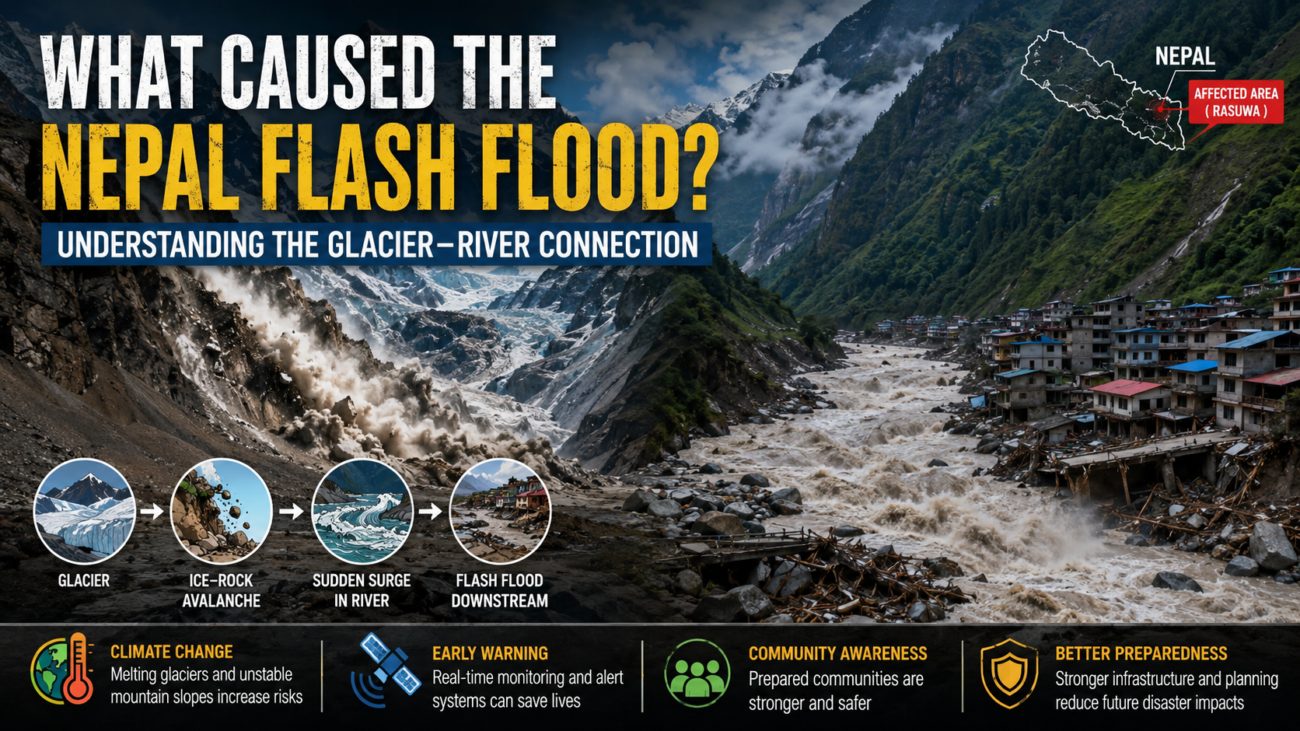
Nepal is famous for its majestic Himalayan mountains, glaciers, rivers and breathtaking landscapes. However, these same natural features can also create serious environmental hazards. The recent flash flood in Nepal has once again highlighted the fragile relationship between glaciers, mountain slopes and rivers. Understanding what caused the flood is important not only for Nepal but also for other Himalayan regions facing increasing climate and weather-related risks.
The Nepal flash flood was not simply an ordinary river overflow. Preliminary assessments indicate that a sudden ice-rock avalanche or glacier-related collapse in the high Himalayan region contributed to the rapid release and movement of water, rocks and sediment into the river system. The resulting flood wave travelled downstream through the Bhote Koshi and Trishuli river systems, creating significant destruction in affected areas.
What Caused the Nepal Flash Flood?
The exact scientific reconstruction of such an event can take time, but the initial evidence points toward a high-altitude glacier and mountain instability event.
A large mass of ice and rock can suddenly break away from a steep mountain or glacier. Because Himalayan slopes are extremely steep, the material can move rapidly downhill. When it reaches a river or tributary, it can displace water, block the river temporarily or trigger a sudden surge.
In this case, scientists have been investigating the possibility that an ice-rock avalanche entered the Lhende Khola, a tributary connected to the Bhote Koshi River. This sudden disturbance is believed to have generated a powerful downstream flood containing water, mud, sediment and large boulders.
This explains why the event developed so quickly and why the flood was capable of causing extensive damage.
Understanding the Glacier–River Connection
To understand this disaster, it is necessary to understand how glaciers and rivers are connected.
Glaciers are enormous natural stores of frozen water. Snow accumulates at high elevations over many years and eventually becomes compressed into ice. Under gravity, glaciers slowly move through mountain valleys.
As temperatures rise, glacier ice melts and produces meltwater. That water enters streams and eventually becomes part of larger river systems.
Therefore, the connection can be simplified as:
Snow → Glacier → Meltwater → Mountain Stream → River → Downstream Communities
Normally, this process is gradual. But when glaciers, ice-covered slopes or surrounding mountain terrain become unstable, the relationship can suddenly change.
A collapse involving ice and rock can introduce a huge amount of material into a river within minutes. This can create a powerful flash flood or debris-rich flow.
Why Was the Flood So Destructive?
One of the major reasons Himalayan flash floods are so dangerous is that they carry much more than water.
The flood can transport:
Large boulders
Mud and sand
Trees
Ice fragments
Loose mountain sediment
Vehicles
Pieces of buildings and bridges
The steep Himalayan landscape gives flowing water enormous energy. As the flood moves downstream, it can erode riverbanks and collect additional material.
This creates a destructive combination of water and debris.
A normal flood may damage buildings through water pressure. A debris-rich flash flood can also smash structures with rocks and boulders, bury roads under sediment and destroy bridges through repeated impacts.
The Role of Climate Change
Climate change is an important part of the larger picture, although it is important not to claim that climate change alone caused this particular flood.
The Himalayan region is experiencing significant changes in glaciers, snow and frozen ground. Rising temperatures can cause glaciers to retreat and alter the physical environment around them.
When glaciers retreat, new lakes can form. At the same time, previously ice-covered mountain slopes can become exposed. Warming can also affect permafrost—the permanently frozen ground found in many high-altitude areas.
If frozen ground thaws, slopes may become less stable. This can increase the potential for rockfalls, landslides and other cascading hazards.
Therefore, climate change can act as a risk multiplier.
The relationship can be represented as:
Rising temperatures → glacier and permafrost changes → greater mountain instability → potential avalanche or landslide → river disturbance → flash flood
This does not mean that every glacier will suddenly collapse. Instead, it means that changing environmental conditions can create new and more complicated risks.
Why Flash Floods Are Difficult to Predict
Predicting glacier-related flash floods is extremely challenging.
Many Himalayan glaciers and mountain slopes are located in remote areas where installing monitoring equipment is difficult. Severe weather, snow, avalanches and extreme terrain can make regular observation complicated.
Scientists can use satellites, drones, seismic instruments and river gauges to monitor potential hazards. However, identifying the exact moment when an unstable mountain mass will collapse remains extremely difficult.
This is why early-warning systems are so important.
A community does not necessarily need to know exactly which glacier has collapsed. If an upstream river sensor detects a sudden and dangerous rise in water level, authorities can issue an emergency warning.
Even a few minutes of warning can provide valuable time for people to move away from river channels and reach higher ground.
Why the Bhote Koshi and Trishuli Rivers Matter
The Bhote Koshi and Trishuli river systems played an important role in the spread of the flood.
Mountain rivers act as natural pathways connecting high-altitude areas with downstream settlements. A disaster that begins in a remote glacier region can therefore travel rapidly through the river network.
This creates a major challenge for disaster management.
People living many kilometres downstream may have no idea that an avalanche or glacier-related event has occurred upstream. They may see clear weather and assume that the river is safe.
However, a flood wave can arrive from upstream even when there is little or no rainfall at their location.
What Can Nepal Do to Reduce Future Risks?
Nepal cannot prevent every avalanche, landslide or glacier collapse. However, it can reduce the impact of these hazards through better preparedness.
Important measures include:
Improved glacier monitoring: High-risk glaciers and glacial lakes should be monitored using satellites and ground-based instruments.
Automatic river gauges: Real-time water-level sensors can detect sudden changes and trigger warnings.
Early-warning systems: Alerts should reach local communities, tourists and infrastructure operators quickly.
Better infrastructure planning: Roads, bridges and hydropower projects should consider extreme flood and debris-flow risks.
Community awareness: People living near rivers should understand evacuation routes and the dangers of approaching rapidly rising water.
Regional cooperation: Himalayan countries need to share relevant information about glaciers, rivers, rainfall and high-altitude hazards.
What Does the Nepal Flood Teach Us?
The Nepal flash flood demonstrates that mountain disasters are becoming increasingly complex. A hazard may begin with an unstable glacier or mountain slope but quickly transform into a river disaster affecting communities and infrastructure far downstream.
The most important lesson is that glaciers and rivers should not be studied as separate systems.
Changes in glaciers can influence water availability, river behaviour and mountain stability. At the same time, rivers can transport the consequences of high-altitude disasters to populated areas.
The Nepal event is therefore a reminder of the need for better scientific monitoring and stronger disaster preparedness across the Himalayan region.
Conclusion
The Nepal flash flood was a powerful example of the interconnected nature of the Himalayas. Preliminary evidence suggests that an ice-rock avalanche or glacier-related collapse contributed to the sudden flood, sending water, rocks and sediment into the Bhote Koshi and Trishuli river systems.
The event highlights an important reality: a disaster can begin high in the mountains but affect people many kilometres downstream.
Climate change is adding another layer of complexity by altering glaciers, snow, permafrost and mountain environments. While climate change cannot automatically be blamed for every individual flood, warming conditions can increase or change certain hazards.
The solution lies in understanding the glacier–river connection, improving monitoring technology, strengthening early-warning systems and preparing communities before disasters happen.
The Himalayas will continue to change. Nepal’s experience shows why the region needs science, technology, cooperation and community preparedness to face the growing risks of mountain-related disasters.

Leave A Comment