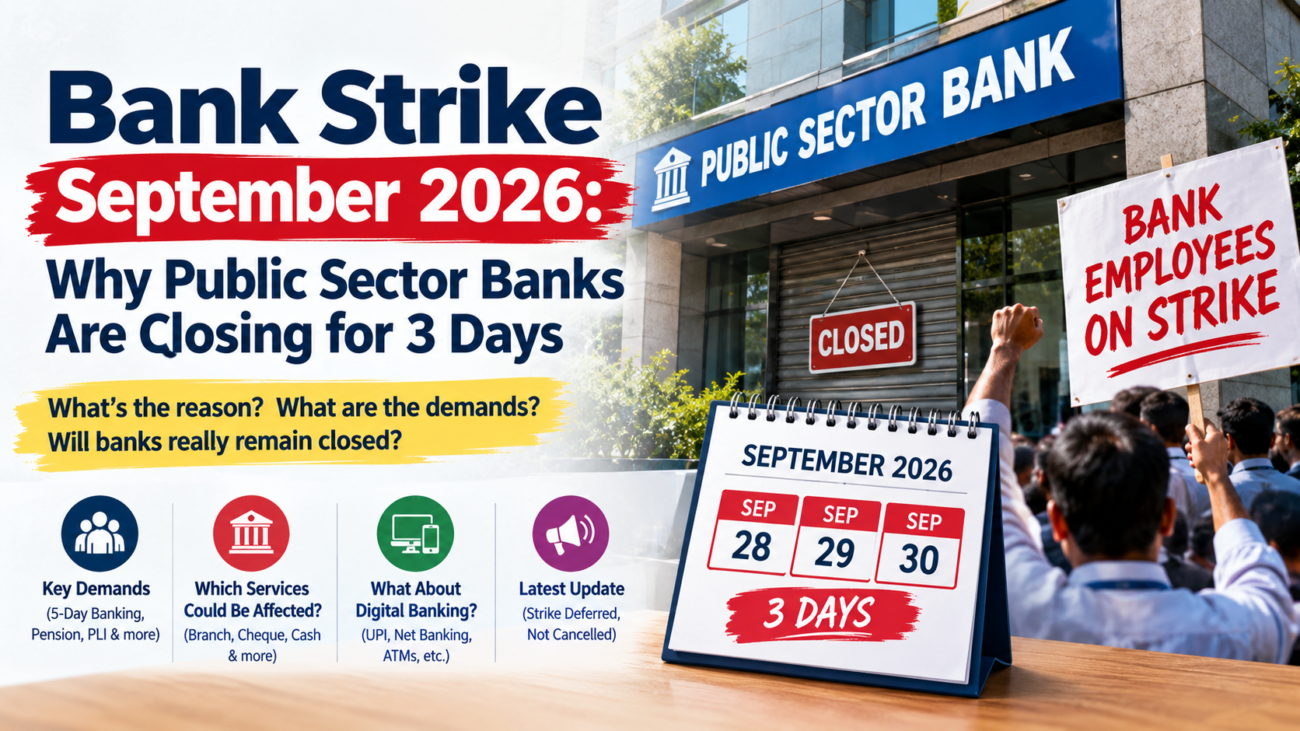
The banking sector in India was heading toward a major disruption at the end of September 2026, with public sector banks and regional rural banks expected to face a three-day nationwide strike from September 28 to September 30. The proposed strike was called by the United Forum of Bank Unions (UFBU) over several employee-related demands, with the implementation of a five-day banking week emerging as the central issue.
However, there has been an important development. On September 28, reports said that the proposed three-day strike had been deferred after discussions between the Indian Banks’ Association (IBA) and UFBU. Therefore, customers should not assume that all public sector bank branches are closed for September 28–30.
Why Was a Three-Day Bank Strike Planned?
The proposed strike was the result of a prolonged dispute between bank employee unions and the authorities over working conditions and other employment-related issues.
According to the Ministry of Finance, UFBU and other unions had called strikes primarily over the demand for five-day banking and issues surrounding the Performance Linked Incentive (PLI) scheme. The government said that the PLI issue had been kept in abeyance, while the five-day workweek remained the principal unresolved demand.
At present, public sector bank employees generally work on Saturdays except for the second and fourth Saturdays, which are holidays. Bank unions have been demanding that all Saturdays should become holidays, effectively creating a five-day working week.
The demand for five-day banking has been under discussion for some time. The unions argue that a five-day schedule would bring banking employees in line with several other financial institutions that already follow a five-day working pattern.
What Other Demands Were Raised?
Although the five-day banking week was the main issue highlighted in the September strike, the unions have also raised other concerns involving employee and retiree benefits.
These have included issues related to pension arrangements, dearness allowance for retirees and other pension-related benefits. Reports also linked the strike to disagreements over changes to the Performance Linked Incentive system.
The government, however, maintained that substantial progress had already been made on some of the concerns raised by the unions. The Finance Ministry appealed to employees to resolve the remaining issues through dialogue rather than industrial action.
Why Was the Timing of the Strike Important?
The proposed strike was particularly significant because it was scheduled for the end of September.
September 26 was the fourth Saturday and September 27 was Sunday. Therefore, a three-day strike beginning on September 28 could have resulted in an extended period during which customers had limited access to physical bank branches.
The timing was also important because September 30 marks the half-yearly closing of banks. The Finance Ministry pointed out that this period is important for activities such as reconciliation, provisioning, treasury operations and other financial processes.
Because of this, the government and banks took measures to reduce the potential disruption.
Why Were Banks Open on Sunday, September 27?
Normally, customers would not expect public sector bank branches to operate on a Sunday. However, the government made a special arrangement for September 27, 2026.
The Ministry of Finance announced that all Public Sector Banks and Regional Rural Banks would function normally on that Sunday to help customers complete important banking work before the proposed strike. The Reserve Bank of India also approved the operation of bank branches, offices, ATM-linked branches and currency chests on that day.
The move was intended to reduce the inconvenience that could have resulted from the combination of the weekend and the proposed three-day strike.
Which Banking Services Could Have Been Affected?
If the strike had proceeded as originally planned, the biggest impact would have been on physical branch services.
Customers could have faced delays in activities such as cash deposits and withdrawals at counters, cheque-related work, demand drafts, account-related documentation and other services requiring employees at bank branches.
Cheque clearing and settlement-related activities could also have experienced delays.
However, digital banking services were expected to remain available. Customers could continue using UPI, internet banking, mobile banking, IMPS and ATMs, although individual services can sometimes experience technical or operational limitations.
Private-sector banks were also expected to be less affected because the strike was primarily associated with unions representing employees in public-sector banking and related institutions.
What Should Bank Customers Do?
With the latest development that the proposed strike has been deferred, customers should check the latest communication from their individual bank before visiting a branch or postponing a transaction.
For urgent transactions, digital channels such as UPI, mobile banking and internet banking can continue to be useful. Customers who need a service that can only be completed at a branch should check the bank’s official communication for operating status.
Those receiving salaries, pensions or government payments should also monitor announcements from their bank or relevant government department. The government had already taken precautionary measures for salary and pension disbursement because of the possibility of banking disruption during the proposed strike period.
What Happens Next?
The September 2026 bank strike illustrates the continuing negotiations over working arrangements in India’s banking sector. The main unresolved issue had been the demand for a five-day banking week, while other employee and pension-related matters have also remained part of discussions.
For now, the key point for customers is that the September 28–30 strike was deferred following discussions between UFBU and IBA, so the situation is different from the original plan for a three-day shutdown.
The development is particularly important for customers because September 30 is the half-yearly closing date for banks. Any major disruption around this period could have affected businesses, government transactions and customers who depend on branch-based services.
Therefore, rather than assuming that public sector banks will remain closed for three days, customers should follow the latest official announcements from their respective banks and the banking authorities.

Leave A Comment