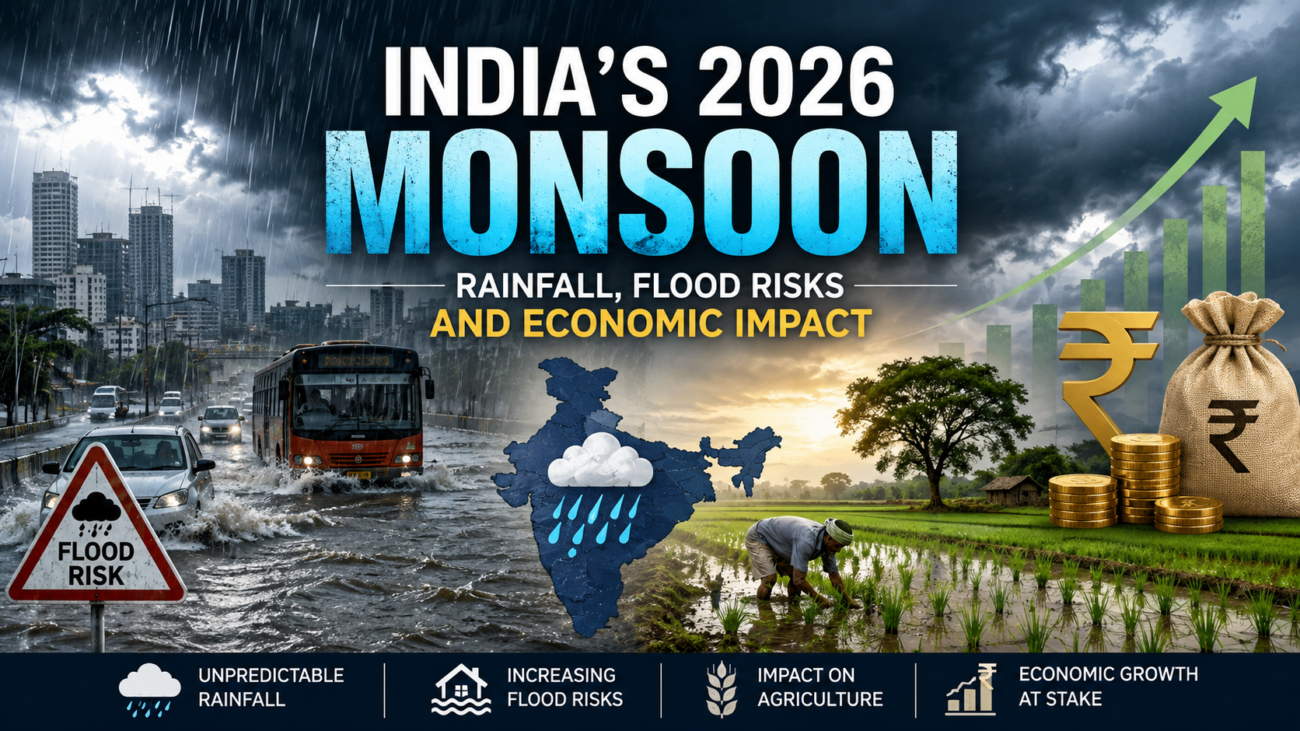
India’s monsoon is much more than a seasonal weather event. It is one of the most important drivers of the country’s agriculture, water supply, rural income, food prices, infrastructure activity and broader economic performance. In 2026, the southwest monsoon has presented a complicated picture: while some regions have experienced intense rainfall and serious flooding, the country as a whole has been facing a significant rainfall deficit. This unusual combination of below-normal seasonal rainfall alongside episodes of extreme rain highlights the growing complexity of India’s monsoon system.
The India Meteorological Department (IMD) had initially forecast the 2026 southwest monsoon to deliver around 90% of the long-period average, with the historical June–September average based on 1971–2020 data standing at about 87 cm. By August, concerns had increased as rainfall remained below normal and El Niño conditions strengthened. Recent reports indicate that India’s seasonal rainfall deficit had reached around 13% by August 24, with the possibility that the final season could become one of the weakest monsoons in many years.
A Monsoon of Uneven Rainfall
One of the defining features of the 2026 monsoon is its uneven distribution. A national rainfall deficit does not mean that every part of India is experiencing dry conditions. Instead, some states have received intense spells of rainfall capable of triggering floods, landslides and urban waterlogging, while other areas have faced prolonged dry periods.
July provided temporary relief, with rainfall close to normal and a reported 1% surplus. However, the improvement was not sufficient to eliminate the accumulated deficit from earlier months. August rainfall was also expected to remain below normal, with the IMD forecasting rainfall at less than 94% of the long-period average for the month.
This uneven distribution is particularly important for agriculture. Crops do not benefit simply from the total amount of rain received during a season. The timing, intensity and geographical distribution of rainfall are equally important. A few days of extremely heavy rain followed by weeks of dry weather can be more damaging than steady, moderate rainfall.
The strengthening El Niño has emerged as an important factor behind the weaker monsoon outlook. El Niño is generally associated with reduced monsoon rainfall over India, although its impact can vary depending on other atmospheric and oceanic conditions.
Why Flood Risk Remains High Despite a Rainfall Deficit
At first glance, a below-normal monsoon might appear to reduce the danger of floods. In reality, flood risk can remain extremely high.
Short-duration extreme rainfall can overwhelm drainage systems, rivers and reservoirs even when cumulative seasonal rainfall is below average. Urban areas are particularly vulnerable because concrete surfaces prevent water from naturally soaking into the ground. Blocked drains, construction over natural water channels and inadequate storm-water infrastructure can further increase the risk.
The 2026 monsoon has already demonstrated this contrast. Assam experienced severe flooding during July, with more than 100 deaths reported and over 700,000 people displaced, according to Associated Press reporting. Experts have pointed to intense rainfall as well as deforestation, sand mining and unplanned development as factors that can worsen flood impacts.
Mumbai has also faced the consequences of intense monsoon weather. A landslide in Ghatkopar linked to heavy rainfall killed at least seven people in August, highlighting the risks created when intense rain interacts with unstable terrain and dense urban development.
The lesson is clear: India does not simply need to prepare for more rain or less rain—it needs to prepare for more unpredictable rainfall patterns.
Impact on Indian Agriculture
Agriculture is perhaps the sector most directly exposed to monsoon performance. The monsoon supplies roughly 70% of India’s annual rainfall and is particularly important because a large share of agricultural land depends on rainfall rather than irrigation.
The 2026 rainfall deficit could create challenges for crops such as cotton, soybean, maize and pulses. These crops require sufficient soil moisture during important stages of development. Although July rainfall helped farmers recover some lost ground, dry spells later in the season could still affect newly planted crops whose root systems remain relatively shallow.
A weaker monsoon can affect agriculture through several channels:
Lower crop yields
Reduced farm incomes
Higher irrigation requirements
Increased dependence on groundwater
Greater volatility in food prices
Reduced rural consumption
Higher government expenditure on agricultural support
However, excessive rainfall creates a different set of problems. Flooding can destroy standing crops, erode fertile soil, damage farm equipment and kill livestock. Therefore, both drought-like conditions and flash flooding can occur within the same monsoon season.
Food Prices and Inflation
The monsoon also has a strong connection with food inflation.
When rainfall is insufficient, production of crops such as pulses, oilseeds and vegetables can decline. Lower supply can put upward pressure on prices. This becomes especially important for households because food represents a significant portion of consumer spending.
A weak monsoon can also influence rural purchasing power. Farmers facing lower yields or higher production costs may reduce spending on consumer goods, vehicles, household products and other non-essential items.
On the other hand, excessive rainfall can damage vegetables and perishable crops, disrupt transportation and temporarily restrict supplies to urban markets. Therefore, even when national food production remains relatively stable, regional weather disruptions can cause noticeable price movements.
Impact on Infrastructure and Cities
India’s rapidly expanding cities face another major challenge from extreme monsoon rainfall.
Flooding can damage roads, bridges, railway tracks, electrical infrastructure, water systems and buildings. Business operations may be interrupted when roads become inaccessible or public transport services are suspended. Heavy rainfall can also affect airports and supply chains.
The economic cost of urban flooding extends beyond the physical damage. Businesses can lose working hours, employees may be unable to reach workplaces, deliveries can be delayed and households may face repair expenses.
This is why investments in storm-water drainage, flood-resilient roads, urban wetlands, early-warning systems and climate-resilient infrastructure are becoming increasingly important.
Effects on Rural and Consumer Demand
The monsoon has traditionally been described as a driver of India’s rural economy because agricultural income influences consumption across thousands of villages and small towns.
A healthy monsoon can improve farm incomes, increase demand for consumer products and support rural businesses. A weak or poorly distributed monsoon can have the opposite effect.
The consequences can spread beyond agriculture. Lower rural income can affect sales of motorcycles, tractors, consumer electronics, packaged goods, clothing and other products. Financial institutions may also see changes in agricultural loan demand and repayment conditions.
For this reason, the monsoon should not be viewed simply as an environmental issue. It is also an important macroeconomic variable.
What 2026 Means for India’s Economy
The economic impact of the 2026 monsoon will depend on how the remaining weeks of the season unfold.
A prolonged rainfall deficit could put pressure on agricultural output, rural incomes, food prices and water availability. Reuters has reported that the weakening monsoon and strengthening El Niño could increase risks for agriculture and food prices, while also affecting soil moisture needed for subsequent winter crops.
At the same time, India’s diversified economy provides some protection against a weak monsoon. Manufacturing, information technology, financial services, construction and other sectors are not directly dependent on rainfall to the same degree as agriculture.
Nevertheless, agriculture remains important because of its influence on employment, rural demand, food supply and inflation.
The Need for Better Flood and Drought Management
The events of 2026 underline the importance of moving beyond traditional disaster management.
India needs systems capable of addressing both water scarcity and excess rainfall. This means improving weather forecasting, strengthening local early-warning systems, expanding rainwater harvesting, protecting wetlands and floodplains, upgrading drainage networks and developing better river-basin management.
Technology can also play a larger role. Satellites, weather radars, artificial intelligence, hydrological models and real-time sensors can help authorities identify dangerous rainfall patterns earlier and communicate warnings to communities.
Flood management should also become more locally focused. A national rainfall average cannot explain what is happening in an individual district. Authorities need highly localized rainfall, river-level and flood-risk information to make effective decisions.
Looking Ahead
India’s 2026 monsoon is an important reminder that average rainfall figures can hide significant regional risks. A season can simultaneously produce serious flooding in one region and agricultural stress in another.
The strengthening El Niño and the country’s rainfall deficit have increased concerns about agriculture and water availability, while episodes of extreme rainfall have demonstrated the continuing threat of floods and landslides. The IMD continues to monitor regional rainfall and extreme-weather conditions, including heavy-rainfall events across different parts of the country.
For India, the long-term challenge is therefore not simply achieving a “normal” monsoon. It is building an economy and infrastructure system that can withstand greater rainfall variability and more frequent extreme weather events.
From farmers and businesses to city planners and policymakers, preparation will become increasingly important. Better forecasting, resilient infrastructure, efficient water management and climate-smart agriculture can reduce the economic damage caused by both floods and rainfall shortages.
Conclusion
India’s 2026 monsoon has become a complex story of rainfall deficits, extreme weather, flood risks and economic uncertainty. While the overall season has been weaker than normal, intense rainfall episodes have still caused devastating floods and landslides in vulnerable areas.
The impact extends far beyond weather. Agriculture, food prices, rural incomes, infrastructure, urban productivity and consumer demand are all connected to the monsoon.
As climate patterns become more unpredictable, India’s future resilience will depend on its ability to prepare for both too little and too much water. The 2026 monsoon therefore offers an important lesson: monsoon preparedness is not only about managing rainfall—it is about protecting India’s economy, communities and long-term development.

Leave A Comment