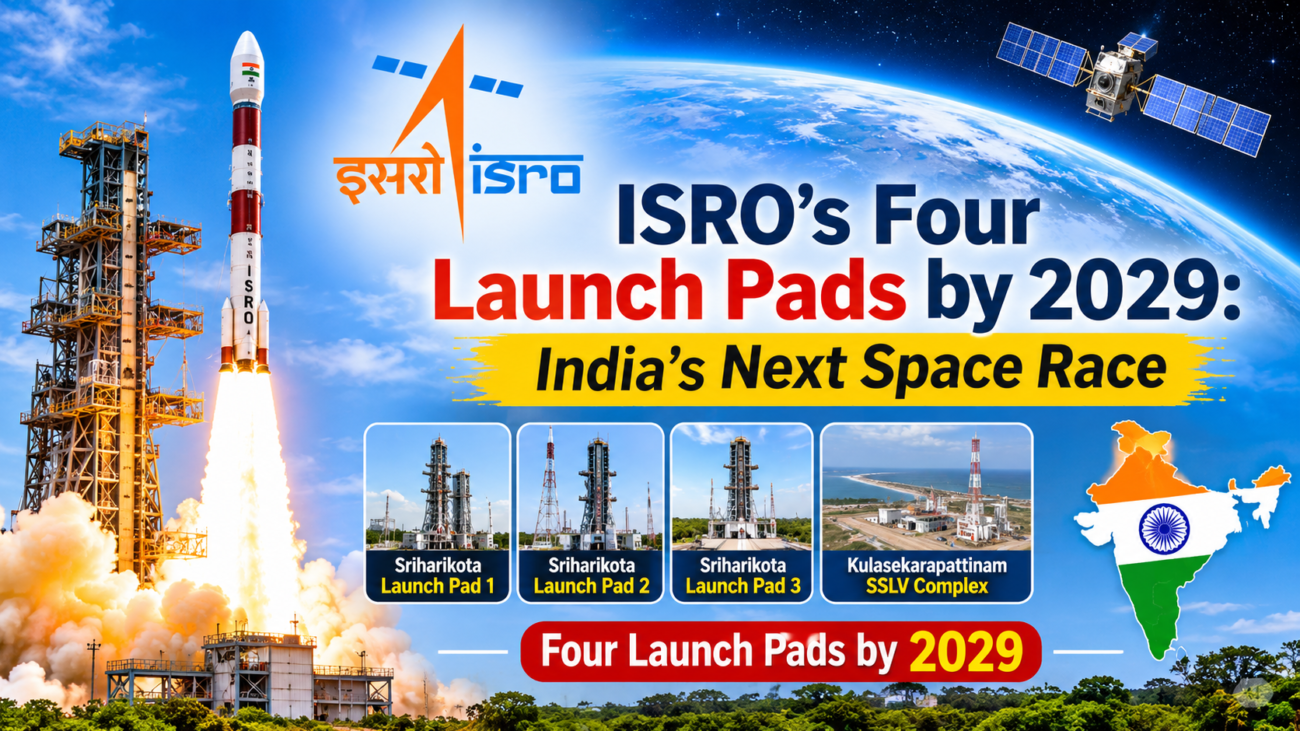
India is preparing for a major transformation in its space exploration journey. The Indian Space Research Organisation (ISRO) is expanding its launch infrastructure with an ambitious target of having four functional launch pads by 2029. This development represents an important step towards strengthening India’s position in the global space industry, increasing satellite launch capabilities and supporting future space exploration missions.
With the growing demand for satellite launches, communication networks, weather forecasting, navigation and Earth observation, India needs stronger and more advanced space infrastructure. ISRO’s expansion plan aims to address these requirements while creating new opportunities for private companies, startups and the country’s growing space technology ecosystem.
India’s Plan to Develop Four Functional Launch Pads
ISRO currently operates two major launch pads at the Satish Dhawan Space Centre (SDSC), located in Sriharikota, Andhra Pradesh. These facilities have played an important role in India’s successful space missions, including Chandrayaan, Mangalyaan and various satellite launches.
According to ISRO Chairman V. Narayanan, India aims to expand its space operations with four functional launch pads by 2029. The expansion includes the development of a third launch pad at Sriharikota and a dedicated Small Satellite Launch Vehicle (SSLV) launch complex at Kulasekarapattinam in Tamil Nadu.
The proposed facilities are expected to improve India’s ability to conduct multiple launches, accommodate different categories of rockets and meet increasing international demand for affordable satellite deployment.
1. First Launch Pad: Supporting PSLV and SSLV Missions
The First Launch Pad at Sriharikota is one of India’s most important space launch facilities. It primarily supports the Polar Satellite Launch Vehicle (PSLV) and Small Satellite Launch Vehicle (SSLV).
PSLV has established itself as one of India’s most reliable launch vehicles. It has successfully carried numerous Indian and international satellites into orbit and played a significant role in missions such as Chandrayaan-1 and India’s Mars Orbiter Mission.
The First Launch Pad will continue supporting satellite deployment, particularly Earth observation and scientific missions. Its continued operation will help ISRO maintain regular launch schedules.
2. Second Launch Pad: Supporting Heavy-Lift Missions
The Second Launch Pad at Sriharikota was developed to support more advanced launch vehicles, including the Geosynchronous Satellite Launch Vehicle (GSLV) and Launch Vehicle Mark-3 (LVM3).
It has been particularly important for India’s ambitious space exploration programmes. The Chandrayaan-3 mission, which successfully achieved a soft landing on the Moon in August 2023, was launched using LVM3.
The Second Launch Pad is also important for India’s human spaceflight programme, Gaganyaan. The human-rated LVM3 rocket will play a crucial role in carrying Indian astronauts into space.
Having two existing operational launch pads provides ISRO with the foundation needed to expand its launch capacity.
3. Third Launch Pad: A New Chapter in India’s Space Programme
One of the most significant developments is the construction of the Third Launch Pad at Sriharikota.
In January 2025, the Union Cabinet approved this project with an estimated investment of ₹3,984.86 crore. The facility is designed to support ISRO’s Next Generation Launch Vehicle (NGLV), along with future heavy-lift missions.
The new launch pad will also serve as a standby facility for the existing Second Launch Pad, improving operational flexibility and reducing dependence on a limited number of launch facilities.
The project is targeted for completion within four years of approval. Government information released in 2026 indicates a target around March 2029 for project completion.
This infrastructure will be important for India’s long-term ambitions, including the development of the Bharatiya Antariksh Station and future human space exploration missions.
4. SSLV Launch Complex: India’s Second Spaceport
Another major development is the construction of a dedicated SSLV launch complex at Kulasekarapattinam in Tamil Nadu’s Thoothukudi district.
The proposed facility covers approximately 2,000 acres and is designed to support Small Satellite Launch Vehicle missions. It will include launch infrastructure, integration buildings, rail-track systems and telemetry, tracking and command facilities.
The location offers geographical advantages for launching satellites into certain polar and sun-synchronous orbits. A dedicated launch facility will help reduce the operational burden on Sriharikota and provide additional flexibility for small satellite missions.
The project is also expected to create opportunities for private space companies and startups interested in developing and launching small satellites.
According to government information released in March 2026, commissioning of this launch complex is expected during the 2026–27 financial year, with SSLV launches anticipated from 2027–28.
How Will Four Launch Facilities Benefit India?
The expansion of India’s launch infrastructure could bring several long-term benefits.
Increased Satellite Launch Capacity: Additional facilities will allow ISRO to handle more satellite launches and improve its ability to meet domestic and international requirements.
Growth of the Commercial Space Industry: India is becoming an attractive destination for affordable satellite launch services. Improved infrastructure could help the country compete with established international space companies.
Support for Private Space Startups: Private companies will have more opportunities to participate in rocket manufacturing, satellite development, launch operations and advanced space technologies.
Employment Opportunities: Infrastructure development will create demand for engineers, scientists, researchers, technicians and skilled workers across the space industry.
Support for Future Space Missions: Advanced launch facilities will be essential for future missions involving human spaceflight, lunar exploration and India’s proposed space station.
The Role of Private Companies in India’s Space Race
India’s space sector is gradually moving towards a more collaborative model involving government organisations and private enterprises.
Following the space sector reforms announced in 2020, private companies received greater opportunities to participate in India’s space activities. Organisations such as IN-SPACe and NewSpace India Limited (NSIL) are helping strengthen this ecosystem.
ISRO Chairman V. Narayanan has also emphasised the importance of supporting startups and private enterprises to meet growing domestic and international satellite launch demand.
This does not mean that ISRO is being privatised. Instead, the objective is to encourage private participation while ISRO continues to lead India’s major scientific and strategic space programmes.
Challenges Ahead of the 2029 Target
Although the four-launch-facility target is ambitious, achieving it will require careful planning, substantial investment and advanced engineering.
Construction delays, equipment installation, safety testing, rocket availability and coordination between government organisations and private companies could affect project timelines.
Additionally, developing new-generation launch vehicles and ensuring reliable operations will require continuous research, technological innovation and skilled manpower.
Therefore, the success of this expansion will depend not only on completing construction but also on making these facilities fully operational.
Conclusion: India’s Growing Ambitions in Space
ISRO’s plan to establish four functional launch pads by 2029 represents an important milestone in India’s space development journey. With the Third Launch Pad at Sriharikota and the dedicated SSLV launch complex at Kulasekarapattinam, India is preparing to strengthen its satellite launch capabilities and expand its presence in the global space economy.
The initiative will support future missions, encourage private sector participation and create new opportunities in science, technology and engineering.
As India moves towards ambitious goals such as Gaganyaan, the Bharatiya Antariksh Station and future lunar exploration, stronger launch infrastructure will be essential. The coming years could therefore prove decisive in determining India’s position in the next global space race.

Leave A Comment